Benzo Withdrawal Insomnia: Why Sleep Breaks, How Long It Lasts, and How It Returns

In brief. Insomnia is one of the most common benzodiazepine withdrawal symptoms, and for some people one of the slowest to settle.[3][5] It happens because the brain's calming system adapted to the medication and needs time to re-tune once the dose comes down.[4] For most people sleep does return. A slow taper, a steady daily rhythm, structured sleep therapy and patience tend to help more than another pill.[2][7]
Why sleep breaks in withdrawal
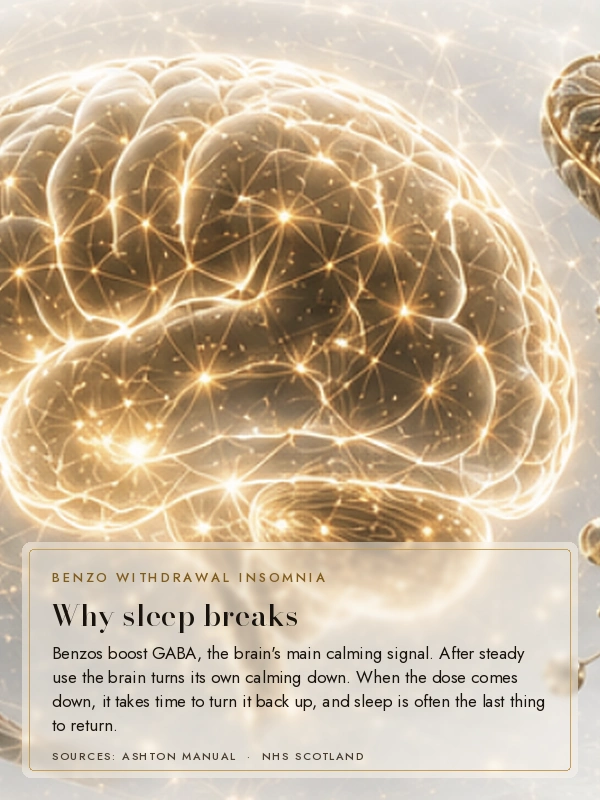
Benzodiazepines work by strengthening GABA, the brain's main calming signal. That is why they can bring sleep on so quickly.
With regular use, the brain adjusts to the extra help. Research reviewed by Professor Heather Ashton of Newcastle University describes how long-term use reduces the sensitivity of the brain's GABA receptors. As those changes slowly reverse after the dose is reduced, withdrawal symptoms decline.[4]
Until they do, the balance between calm and alertness is tilted. The body's alerting systems can run a little hot at exactly the hour you want them to rest.
Many people describe it the same way:
- Lying awake for hours, tired but wired.
- Falling asleep, then waking at two or three in the morning and staying awake.
- Light, broken sleep that does not feel restoring.
- Vivid dreams or nightmares.[4][6]
- Muscle tension, a racing heart or restlessness at night.
There is a second reason sleep can break, and it often begins before the taper does.
Professor Ashton noted that tolerance to the sleep-inducing effects of benzodiazepines can develop within days to weeks of regular use.[3] Many people find their prescription no longer gives them the sleep it once did, even before they begin to come off it.
Then there is rebound insomnia. When a sleeping medication is stopped, sleep can for a time be worse than it was before the medication was started. Professor Ashton noted that rebound insomnia has been described even in people who took benzodiazepines for short periods.[4]
It is especially relevant for sleep-focused benzodiazepines such as Restoril (temazepam) and Halcion (triazolam), which leave the body relatively quickly. Temazepam's half-life is roughly 8 to 22 hours, and triazolam's about 2 hours.[10] Our guide to temazepam withdrawal and sleep covers this in more detail.
None of this means something is broken for good. It means a system that adapted once is now adapting back.
How long it usually lasts
There is no single answer. Dose, duration of use, the drug itself and, above all, the speed of the taper all shape how long sleep stays disturbed.
In the studies Professor Ashton reviewed, insomnia and nightmares were among the symptoms that peaked early in withdrawal and then declined. The acute withdrawal period was often estimated at a few weeks, with a peak around two weeks after stopping.[4]
For some people it takes longer. One study she cited found that symptoms after low-dose use typically took six to twelve months to subside completely.[4]
NHS Scotland guidance estimates that up to 15 percent of people have withdrawal symptoms that last for months.[5] A 2023 survey of people who had taken benzodiazepines, published in PLOS ONE, found that sleep problems were among the symptoms many respondents reported long after stopping. It was a self-selected survey, so it describes the experience of those who answered rather than everyone who tapers.[9]
Those numbers can feel heavy. Two things balance them.
First, most people do not fall into the long tail. Second, even for those who do, Professor Ashton wrote that eventual recovery appears to be the rule.[6]
Sleep often returns in a pattern rather than a straight line. A few good nights, then a rough patch, then a better run. Many people notice the improvement only when they look back across several weeks.
For the wider picture of how each symptom tends to move over time, see our benzo withdrawal timeline.
What helps (without more pills)

The single most important factor is one you share with your prescriber: the pace of the taper.
The 2025 joint guideline on benzodiazepine tapering recommends starting with reductions of 5 to 10 percent every two to four weeks, generally not more than 25 percent every two weeks, adjusted to how you respond, with pauses allowed.[2] If sleep has collapsed after a step, a pause is a reasonable conversation to have.
When a daily dose is split, the guideline also suggests deciding which dose to reduce first by what troubles you most. If insomnia is the main concern, a clinician may reduce an earlier dose first and leave the night dose for later.[2]
Beyond the taper, the best-studied help for long-term insomnia is cognitive behavioral therapy for insomnia, often called CBT-I. The American Academy of Sleep Medicine gives it a strong recommendation as a treatment for chronic insomnia in adults.[7]
CBT-I is more structured than general sleep advice. Its core parts include:
- Stimulus control. The bed is for sleep. If you are awake and frustrated, you get up, do something quiet in low light, and return when sleepy.
- Sleep restriction. Time in bed is matched to the sleep you are actually getting, then gently widened as sleep consolidates.
- Relaxation training. Slow breathing and muscle relaxation to ease the body down.
- Working with the thoughts. Loosening the fear of not sleeping, which can keep people awake on its own.[7]
Sleep restriction can be demanding during withdrawal and should be guided by a trained clinician, especially if you are very sleep-deprived.
There is also direct evidence for combining these approaches with a taper. In a randomized trial of older adults with insomnia who were coming off long-term benzodiazepines, adding cognitive behavioral therapy to a gradual taper helped considerably more people stop and stay stopped than tapering alone.[8]
Simple daily habits support all of this:
- The same wake time every day, including after a bad night.
- Daylight and gentle movement in the morning.
- A wind-down hour with dim light before bed.
- A cool, dark, quiet bedroom.
On their own, these habits are usually not enough for chronic insomnia; the Academy advises against using general sleep hygiene as a single treatment.[7] Alongside a slow taper and structured therapy, they give sleep a steady frame to return to.
What makes it worse
Some things that feel helpful at midnight make the following weeks harder.
Alcohol. It can make you drowsy, but it tends to fragment sleep later in the night. Combined with a benzodiazepine, it can dangerously deepen sedation and slow breathing.
Taking extra doses or adding other sleeping pills on your own. Professor Ashton cautioned against replacing one dependence with another.[6] Any sleep medication, including over-the-counter products and supplements, should be discussed with your prescriber first.
Cutting too fast. Professor Ashton observed that people who develop severe withdrawal symptoms have usually come off too rapidly.[3]
Caffeine late in the day, long afternoon naps, and hours spent lying awake in bed. Each can keep the alerting system switched on.
An unsettled gut. Withdrawal often affects digestion too, and nausea, cramping or bloating can make nights harder. Our guide to benzo belly and gut symptoms explains why.
When to see a doctor
Talk to your prescriber soon if:
- You are sleeping only a few hours a night for more than a week or two.
- Sleep has collapsed after a dose reduction.
- You are thinking about taking more of your medication, or adding something else to sleep.
- Lack of sleep is affecting your safety, for example while driving.
Some situations need help now. A seizure, new confusion, hallucinations or chest pain are emergencies; call 911. If prolonged sleeplessness brings thoughts of suicide or self-harm, call or text 988 to reach the Suicide and Crisis Lifeline.
The FDA's Boxed Warning on every benzodiazepine states that stopping suddenly or reducing the dose too quickly can cause withdrawal reactions, including seizures, which can be life-threatening.[1] Bad nights are never a reason to stop abruptly.
How we support sleep at the sanctuary
Sleep is often the symptom that brings people to us. Many of the people I have worked with were simply following their prescription, and by the time they called they had not slept properly in months.
At Benzo Detox Protocol, the benzo program is built for people who could not get off at home, or who tried a detox and went back up. Most guests stay about twelve weeks; harder cases can take longer. Care runs around nine hours a day, one to one, with 24-hour nursing, private suites and no group therapy. Nights are watched over, not left to chance.
The taper is medically supervised and paced individually by the medical team, so a hard run of nights can mean a slower step rather than a push forward. Alongside it, depending on the person, care can include the Brain Repair IV Drip, a proprietary formulation incorporating amino acids, peptides, and a nature-derived alkaloid. It is one component of a comprehensive, individualized protocol, intended to support the body and brain during recovery, not presented as a guaranteed cure. Nutrition and superfoods, red light therapy, the hyperbaric chamber, infrared sauna and detox baths may also be part of the plan. We do not promise that any of these will bring sleep back on a schedule.
Screening before arrival can include bloodwork, an EKG and blood pressure. In fifteen years, no guest has had a seizure here. That is a record of the past, not a guarantee, and safety comes first in every taper.
You can read how our 12-week benzo detox program works.
Questions about benzo withdrawal insomnia
Why can't I sleep in benzo withdrawal?
Benzodiazepines strengthen the brain's calming signal, and with regular use the brain adapts to them. When the dose comes down, that calming system takes time to re-tune, and sleep is often one of the first things affected.
How long does benzo withdrawal insomnia last?
For many people it is worst in the first weeks and then eases, especially with a slow taper. For some it lasts months. Sleep usually improves in an uneven pattern rather than a straight line.
What is rebound insomnia?
It is a period after stopping a sleeping medication when sleep is worse than it was before the medication was started. It is a recognized withdrawal effect, and it usually settles with time.
Should I take another sleeping pill to get through it?
Please talk to your prescriber first. Adding medications on your own can cause new problems, including a new dependence. Slowing or pausing the taper is often discussed before anything is added.
Does CBT-I work during benzo withdrawal?
CBT-I is the most strongly recommended treatment for chronic insomnia, and a randomized trial found that adding cognitive behavioral therapy to a gradual taper helped more older adults come off benzodiazepines.
Will my sleep ever be normal again?
For most people, yes. Professor Ashton wrote that eventual recovery appears to be the rule. It can take patience, and it helps to measure progress over weeks rather than nights.
Sources
- FDA Drug Safety Communication: Boxed Warning for the benzodiazepine class (2020)
- Joint Clinical Practice Guideline on Benzodiazepine Tapering, Journal of General Internal Medicine (2025)
- Ashton CH. Benzodiazepines: How They Work and How to Withdraw (The Ashton Manual)
- Ashton CH. Protracted withdrawal syndromes from benzodiazepines
- NHS Scotland. Benzodiazepines and Z-drugs: discontinuation and withdrawal symptoms
- Ashton CH. Benzodiazepine dependence and withdrawal: an update (1985)
- Edinger JD et al. Behavioral and psychological treatments for chronic insomnia disorder in adults: an American Academy of Sleep Medicine clinical practice guideline. J Clin Sleep Med (2021)
- Baillargeon L et al. Discontinuation of benzodiazepines among older insomniac adults treated with cognitive-behavioural therapy combined with gradual tapering: a randomized trial. CMAJ (2003)
- Ritvo AD et al. Long-term consequences of benzodiazepine-induced neurological dysfunction: a survey. PLOS ONE (2023)
- Ashton CH. Benzodiazepine Equivalence Table