Benzo Withdrawal Seizures: Why They Happen, Who Is Most at Risk, and How a Slow Taper Lowers the Risk
In brief. A seizure is the most serious risk of coming off a benzodiazepine too quickly. In 2020 the FDA added a Boxed Warning to every drug in the class, stating that abrupt discontinuation or rapid dose reduction can cause withdrawal reactions, including seizures, which can be life-threatening.[1] Seizures are uncommon, and they are usually linked to stopping high doses fast.[2] A slow, individualized taper, set with a clinician, is the most reliable way to lower the risk.[5][6]
Why stopping suddenly can cause a seizure
Benzodiazepines work by strengthening GABA, the brain's main calming signal.
With steady use, the brain adjusts to that extra calm. It turns its own braking system down, because the medication is doing part of the work. The FDA notes that this physical dependence can develop after several days to weeks of regular use, even when the medication is taken exactly as prescribed.[1]
When the medication is removed all at once, the brakes the brain has come to rely on are suddenly gone, and its own have not yet come back up to strength.
For most people, that imbalance shows up as anxiety, broken sleep, tremor and a racing heart. For a smaller number, the nervous system becomes excitable enough to produce a seizure.
NHS guidance describes it plainly: abrupt cessation may produce confusion, psychosis or convulsions, and convulsions are rare and usually occur with rapid withdrawal from high doses.[2] Professor Heather Ashton, who ran a benzodiazepine withdrawal clinic in Newcastle for many years, wrote that fits may occur after rapid dose reduction.[5]
The word that keeps returning in every source is speed. The risk is tied less to the decision to stop than to how fast the dose comes down.
That is also why a seizure can come as a shock. Many of the people I have worked with had never had one in their lives. They were simply following their prescription, and then stopped the way they had been told they could.
When the risk is highest, drug by drug

The timing depends largely on how quickly a medication leaves the body, measured by its half-life.
Short-acting benzodiazepines drop fast, so withdrawal arrives fast. NHS guidance notes that withdrawal symptoms may begin within a day of stopping a short-acting medication such as lorazepam, and at any point up to three weeks after stopping a long-acting one.[2]
For Xanax (alprazolam), the prescribing information is specific. In the cases it describes, the risk of seizure seemed to be greatest 24 to 72 hours after the medication was stopped.[3] Our Xanax withdrawal guide covers the full timeline.
Long-acting medications such as Klonopin (clonazepam) and Valium (diazepam) leave the body more slowly. Diazepam also breaks down into an active byproduct that lingers for days. Professor Ashton observed that with diazepam, the delay before withdrawal begins can be five to seven days.[5] A later start is not a smaller risk. It simply means the dangerous window can open after someone feels they are already through the worst.
| Medication | Approximate half-life | When withdrawal may begin |
|---|---|---|
| Halcion (triazolam) | About 2 hours | Within hours to a day[2] |
| Xanax (alprazolam) | 6 to 12 hours | Within hours; seizure risk greatest at 24 to 72 hours[3] |
| Ativan (lorazepam) | 10 to 20 hours | Within about a day[2] |
| Restoril (temazepam) | 8 to 22 hours | Within a day or two |
| Klonopin (clonazepam) | 18 to 50 hours | Often several days later, up to about three weeks[2] |
| Valium (diazepam) | 20 to 100 hours; active byproduct 36 to 200 hours | Often five to seven days later[5], up to about three weeks[2] |
Half-lives are from the Ashton equivalence table.[4] Timing varies from person to person, so treat the table as a general guide, not a calendar. Our Klonopin withdrawal guide explains why a long-acting medication can make withdrawal appear days after the last dose.
Who is most at risk
No one can predict with certainty who will have a withdrawal seizure. The sources do point to the same handful of factors.
- Stopping abruptly or cutting fast. This is the factor named in every source, from the FDA to the NHS.[1][2]
- Higher doses. NHS guidance links convulsions to rapid withdrawal from high doses.[2] The Xanax prescribing information notes that the risk and severity of dependence appear greater at doses above 4 mg a day.[3]
- Longer use. The same prescribing information associates greater risk with treatment for long periods, more than twelve weeks.[3]
- Potent, short-acting medications. Professor Ashton observed that potent benzodiazepines with short half-lives, such as alprazolam and lorazepam, appear to carry the highest risk of dependence problems.[9]
- Other substances. Alcohol acts on the same calming system. Drinking while tapering, or stopping alcohol at the same time, is something the medical team will want to know about well in advance.
A personal or family history of seizures, other prescribed medications and any other health conditions also belong in the conversation before a taper begins. They shape how cautious the plan needs to be.
For a wider look at the most serious outcomes, including what the evidence does and does not say, see can you die from benzo withdrawal.
How tapering lowers the risk
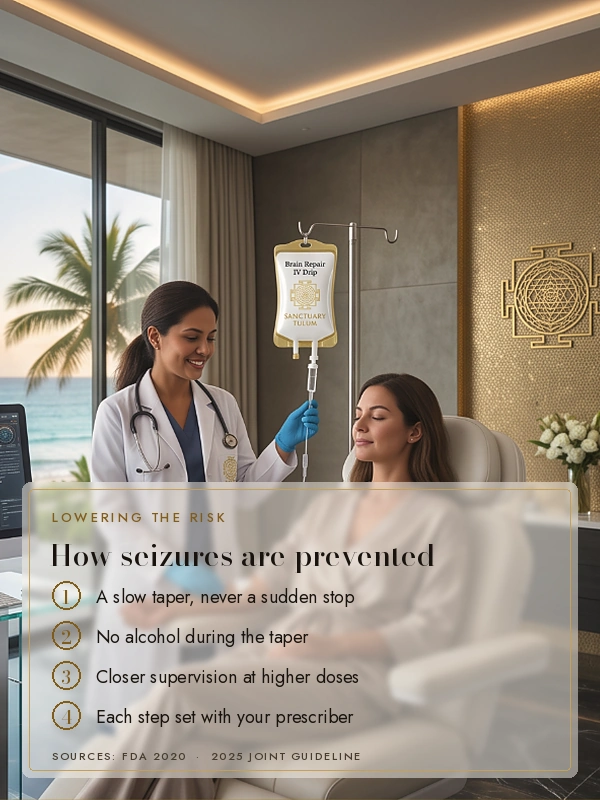
If speed is the problem, pace is the answer.
A gradual taper gives the brain time to bring its own calming system back up as the medication comes down. Professor Ashton observed that people who develop severe withdrawal symptoms have usually come off too rapidly.[8]
In 2025, the American Society of Addiction Medicine and nine other medical organizations published a joint guideline on benzodiazepine tapering.[6][7] Its core recommendations:
- Begin with reductions of about 5 to 10 percent of the daily dose every two to four weeks.
- Generally do not reduce by more than 25 percent every two weeks.
- Adjust the pace to how the person responds. Pausing is allowed.
- Make the plan together, with the patient's preferences in the room.
For people on short-acting medications, some clinicians switch to a long-acting benzodiazepine such as diazepam before tapering. Professor Ashton described this approach because a long-acting medication produces a smoother fall in blood levels and allows smaller, steadier steps.[10] Whether it is right for you is a decision for your prescriber.
A few practical habits can support a safer taper:
- Keep to the schedule. Avoid skipping doses and catching up later.
- Avoid alcohol completely while tapering.
- Tell your prescriber about every other medication and supplement you take.
- Report new or worsening symptoms early, especially confusion, muscle jerks or a sense that something is badly wrong.
For a week-by-week view of what tapering and withdrawal can involve, see the benzo withdrawal timeline.
What to do if someone has a seizure
A seizure during benzodiazepine withdrawal is a medical emergency. Call 911, or your local emergency number, right away.
While you wait, the CDC's general seizure first-aid guidance applies:[11]
- Stay with the person and stay calm. Note the time the seizure starts.
- Ease them to the floor and gently turn them onto one side to help them breathe.
- Clear the area of anything hard or sharp, and put something soft under their head.
- Loosen anything tight around the neck, and remove glasses.
- Do not put anything in their mouth, and do not hold them down.
- Stay with them until help arrives and they are fully awake.
When the paramedics arrive, tell them which medication the person takes, the usual dose, and when it was last taken or reduced. That information can change how they treat the seizure.
Afterward, the person should not simply resume or stop their medication on their own. The next step is a plan made with a clinician.
Medically supervised detox
Some people taper safely at home with a prescriber they trust. Others carry more of the risk factors above, or have tried before and had to go back up. For them, inpatient benzo detox adds round-the-clock monitoring while the dose comes down.
At Benzo Detox Protocol, the benzo program is built for people who could not get off at home, or who tried a detox and went back up. Most guests stay about twelve weeks; harder cases can take longer.
Screening before arrival can include bloodwork, an EKG and blood pressure. The taper is then paced individually by the medical team, with 24-hour nursing, private suites and around nine hours a day of one-to-one care. There is no group therapy.
Alongside the taper, depending on the person, care can include the Brain Repair IV Drip, a proprietary formulation incorporating amino acids, peptides, and a nature-derived alkaloid. It is one component of a comprehensive, individualized protocol, intended to support the body and brain during recovery, not presented as a guaranteed cure. Nutrition and superfoods, red light therapy, the hyperbaric chamber, infrared sauna and detox baths may also be part of the plan. Not every guest receives every therapy.
In fifteen years, no guest has had a seizure here. That is a statement about the past, built on screening and monitoring, not a guarantee about the future. Safety comes first, and every taper is treated as if it carries real risk.
See how our benzo detox center works.
Questions about benzo withdrawal seizures
How long after stopping benzos can a seizure happen?
It depends on the medication. With Xanax, the prescribing information notes the risk seemed greatest 24 to 72 hours after stopping. With long-acting medications such as Valium or Klonopin, withdrawal may not begin for several days and can appear up to about three weeks later.
Are benzo withdrawal seizures common?
No. NHS guidance describes convulsions as rare and usually linked to rapid withdrawal from high doses. They are serious enough that every taper should be planned to avoid them.
Can you have a Xanax withdrawal seizure on a low dose?
The risk appears higher with higher doses and longer use, but a low dose does not make abrupt stopping safe. The FDA warning applies to the whole class, at any dose.
Does tapering prevent seizures completely?
No method can promise that. A slow, individualized taper is the approach the 2025 joint guideline recommends because it greatly lowers the risk compared with stopping suddenly.
I missed a few doses and feel shaky. What should I do?
Contact your prescriber today and explain what happened. Do not take extra doses to catch up unless you are told to. If you have a seizure, severe confusion or chest pain, call 911.
Is it safer to switch to Valium before tapering?
Some clinicians switch people from short-acting medications to diazepam because it leaves the body slowly and allows smaller steps. It is a decision to make with your prescriber.
Sources
- FDA Drug Safety Communication: Boxed Warning for the benzodiazepine class (2020)
- NHS Scotland. Benzodiazepines and Z-drugs: discontinuation and withdrawal symptoms
- Alprazolam prescribing information: drug abuse, dependence and withdrawal
- Ashton CH. Benzodiazepine Equivalence Table
- Ashton CH. Benzodiazepine dependence and withdrawal: an update (1985)
- Joint Clinical Practice Guideline on Benzodiazepine Tapering, Journal of General Internal Medicine (2025)
- American Society of Addiction Medicine. New tapering guideline announcement (2025)
- Ashton CH. Benzodiazepines: How They Work and How to Withdraw (The Ashton Manual)
- Ashton CH. Guidelines for the rational use of benzodiazepines
- Ashton CH. Reasons for a diazepam (Valium) taper
- Centers for Disease Control and Prevention. First aid for seizures