Inpatient Benzo Detox: Round-the-Clock Care While You Taper, and Who It Is Right For

In brief. Inpatient benzo detox means you live on site while your benzodiazepine is tapered, with nursing care around the clock. It is not the right choice for everyone. Many people can taper safely at home with their prescriber. Inpatient care is worth considering when home tapering has failed, when the dose or history carries higher risk, or when daily life cannot hold the process. Whatever the setting, the taper itself should be gradual: current guidance suggests starting with reductions of 5 to 10 percent every two to four weeks.[1][2]
What inpatient benzo detox means
Inpatient, or residential, detox means the taper happens where you are cared for day and night.
You sleep, eat and rest on site. Nurses are present around the clock. The medical team sees how you respond to each reduction, rather than hearing about it weeks later at an appointment.
That matters because of how benzodiazepines work. With steady use, the brain adapts to the medication. The FDA notes that physical dependence can develop after several days to weeks of regular use, and that stopping suddenly or reducing the dose too quickly can cause withdrawal reactions, including seizures, which can be life-threatening.[3]
Withdrawal symptoms most often include anxiety, broken sleep, irritability, tremor and sensory changes. Seizures are rare, and are usually tied to stopping high doses quickly.[5]
It is important to be clear about one thing. Inpatient should never mean fast.
The word "detox" can suggest a few days of flushing something out. With benzodiazepines, that picture is misleading. Professor Heather Ashton, who ran a benzodiazepine withdrawal clinic for many years, generally favored slow, gradual tapers and cautioned against withdrawing long-term users too quickly.[4] The 2025 joint guideline from the American Society of Addiction Medicine and nine other organizations takes the same view.[1][2]
At 5 to 10 percent every two to four weeks, the arithmetic alone means a full taper is measured in months. A good inpatient setting gives that slow process more safety and more support. It does not compress it.
Who inpatient benzo detox is for
Many people taper successfully at home. If that is working for you, there may be no reason to change.
The 2025 guideline encourages clinicians to match the level of care to the person, and to consider a more structured or supervised setting for people at higher risk.[1] In practice, inpatient care is often considered when one or more of these apply:
- You have tried to taper at home, or in a short detox, and had to go back up.
- You have had a withdrawal seizure or severe withdrawal symptoms before.
- You take a high dose, or have taken benzodiazepines for many years.
- You take other medications or substances alongside your benzodiazepine, including alcohol.
- You are sleeping only a few hours a night for weeks at a time, and work, family or safety is suffering.
- Your home life cannot give you the rest and quiet that a taper requires.
Most of the people who come to us have already tried. Many of them were simply following their prescription for years before anyone mentioned what stopping would involve.
Some situations need a different level of care first, such as an acute psychiatric crisis or a medical condition that requires a hospital. A responsible center will tell you that plainly.
Inpatient vs outpatient, side by side
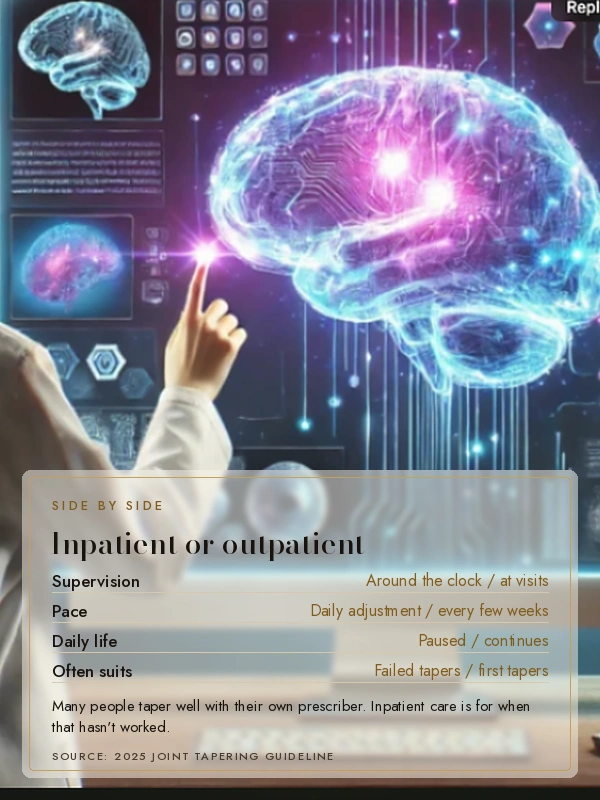
Both settings can be safe. They suit different people at different moments.
The table below sets out the general differences. It describes the settings in broad terms, not any particular provider.
| Outpatient taper | Inpatient taper | |
|---|---|---|
| Where you live | At home, with normal routines | On site, for the length of the stay |
| Supervision | Regular appointments with a prescriber | Nursing around the clock, daily medical review |
| Pace | Gradual, adjusted at each appointment | Gradual, adjusted as often as needed |
| Response to a hard day | Often by phone, or at the next visit | Seen and addressed the same day |
| Who it often suits | Stable situation, lower risk, good support at home | Past failed tapers, higher risk, or a home life that cannot hold the process |
| Main trade-off | Stays within daily life, with less support between visits | Time away from home, with far more support |
Neither setting changes the basic principles of a safe taper. The 2025 guideline asks clinicians to start slowly, generally not to exceed 25 percent every two weeks, to adjust to how the person responds, and to allow pauses.[1]
It also asks that the plan be made together, with the patient's preferences part of the decision.[1][2] That applies just as much inside a center as it does at home.
What inpatient care adds is closeness. A reduction that is not going well can be noticed within hours. Sleep, nutrition and stress, the things that often derail a taper at home, can be supported directly.
There is also a quieter difference. At home, the hardest hours of a taper are often the ones spent alone, late at night, wondering whether a new symptom is normal. In a residential setting, that question can be asked and answered in the moment.
Many guests tell us that knowing someone is close by makes the hardest nights easier to bear.
Outpatient tapering has real advantages too. You stay with your family, keep working if you are able, and learn to manage symptoms within the life you will return to. For many people, that is the right path.
Before deciding, it helps to understand the shape of withdrawal itself. Our main page on the benzo withdrawal timeline shows how symptoms tend to unfold, drug by drug.
If you are tapering at home and it is working, keep going with your prescriber. If it has stalled more than once, that is useful information, not a failure.
What a day looks like

No two days are the same, and they should not be. What follows describes the shape of a day at Benzo Detox Protocol. The actual plan is set for each person and changes as they respond.
Morning. The nursing team checks in, including vital signs, and asks how you slept. Anything that changed overnight is passed to the medical team, who review the taper.
Nourishment. Meals are built around nutrition and superfoods. Many guests arrive with poor appetite or a difficult gut, and food is adapted to what the body can manage that day.
Restorative care. Depending on the person, the day may include the Brain Repair IV Drip, a proprietary formulation incorporating amino acids, peptides, and a nature-derived alkaloid. It is one component of a comprehensive, individualized protocol, intended to support the body and brain during recovery, not presented as a guaranteed cure. Other sessions may include red light therapy, the hyperbaric chamber, infrared sauna or detox baths. Not every guest receives every therapy.
One-to-one time. Around nine hours of the day are one-to-one care. There is no group therapy. The pace is yours.
Rest. Time to rest, and, on the days you feel able, to move gently. Withdrawal is tiring, and recovery needs quiet as much as it needs care.
Night. Nursing continues overnight. If sleep is broken or symptoms flare, someone is there.
How long inpatient benzo detox takes
Length depends on the medication, the dose, how long it has been taken and how the person responds. No honest provider can give you an exact date before they have met you.
Our programs run about twelve weeks for most guests. Harder cases, such as long histories, several medications or previous failed tapers, can take sixteen weeks or longer.
The length is set by safety, not by the calendar. The medical team may lengthen any part of the plan if your body needs more time.
Twelve weeks may sound long for a detox. Measured against a taper that follows current guidance, it is a focused period of support rather than a rush.[1]
At Benzo Detox Protocol, the benzo program is built for people who could not get off at home, or who tried a detox and went back up. Screening before arrival can include bloodwork, an EKG and blood pressure, so the plan begins with a clear picture of your health. Each guest has a private oceanfront suite, 24-hour nursing and around nine hours a day of one-to-one care, while the medical team paces the taper individually. In fifteen years, no guest has had a seizure here. That is a record of the past, not a promise about the future. See how our benzo detox center's 12-week program works, or read what luxury benzo detox means in our setting.
Questions to ask any center
Whether you choose us or somewhere else, these questions can help you judge any inpatient benzo detox:
- How is the taper paced? Listen for gradual, individualized reductions that can slow down or pause. Be cautious of a fixed timetable of a few days or weeks.
- Who decides each reduction? It should be a licensed member of the medical team, reviewing how you are responding.
- Is nursing available around the clock? Withdrawal does not keep office hours.
- What screening happens before admission? A careful center will want your full medication history and a picture of your physical health.
- How are other medications and conditions handled? Ask how they manage complex cases, and when they would refer you elsewhere.
- Will they coordinate with your own prescriber? With your permission, they should.
- What happens when you leave? Ask what the plan is if you are not fully tapered by discharge.
- What do they not promise? A center that is honest about the limits of what it can offer is often more trustworthy than one that promises everything.
Questions about inpatient benzo detox
Do I need inpatient detox to come off benzodiazepines?
Not necessarily. Many people taper safely at home with their prescriber. Inpatient care is often considered after failed attempts, with higher doses or long use, with a history of severe withdrawal, or when home life cannot support the taper.
Is inpatient benzo detox faster?
It should not be. A safe taper is gradual wherever it happens. Inpatient care adds supervision and support so the taper can be adjusted quickly, not shortened.
How long is your inpatient program?
Most guests stay about twelve weeks. Harder cases can take sixteen weeks or longer. Your screening and your response to the taper set the length.
Will I have withdrawal symptoms during inpatient detox?
You may. No one can honestly promise a symptom-free withdrawal. The aim is to keep the taper safe and the symptoms as manageable as possible, with support close at hand.
Is there group therapy?
Not at Benzo Detox Protocol. Care is one-to-one, around nine hours a day, in a private suite.
What happens before I arrive?
A confidential screening call, and screening that can include bloodwork, an EKG and blood pressure, so the medical team can plan your taper before you travel.
Sources
- Joint Clinical Practice Guideline on Benzodiazepine Tapering, Journal of General Internal Medicine (2025)
- American Society of Addiction Medicine. New tapering guideline announcement (2025)
- FDA Drug Safety Communication: Boxed Warning for the benzodiazepine class (2020)
- Ashton CH. Benzodiazepines: How They Work and How to Withdraw (The Ashton Manual)
- NHS Scotland. Benzodiazepines and Z-drugs: discontinuation and withdrawal symptoms