Benzodiazepine Withdrawal Treatment: Your Options, Compared, and How to Choose the Right One
In brief. The treatment for benzodiazepine withdrawal is, above all, a gradual taper that is adjusted to the person. The 2025 joint guideline suggests starting with reductions of 5 to 10 percent every two to four weeks, generally not more than 25 percent every two weeks, with pauses allowed.[2] Many people taper successfully with their own prescriber as outpatients. Inpatient or residential care is a reasonable choice when closer monitoring is needed or when home attempts have not held.[2]
The core of treatment: a slow, supervised taper
There is no pill that switches benzodiazepine withdrawal off.
What helps most is time, and a dose that comes down at a pace the nervous system can follow. Every serious source on this subject agrees on that point, from Professor Heather Ashton's decades of clinical work to the guideline published by the American Society of Addiction Medicine and its partner organizations in 2025.[2][3][4]
The reason is physical. Benzodiazepines such as Xanax (alprazolam), Ativan (lorazepam), Klonopin (clonazepam) and Valium (diazepam) strengthen GABA, the brain's main calming signal. With regular use, the brain adapts. The FDA notes that physical dependence can develop after several days to weeks of regular use, even at prescribed doses.[1]
When the medication is removed too quickly, that adaptation is suddenly unopposed. The FDA's Boxed Warning states that abrupt discontinuation or rapid dose reduction can cause withdrawal reactions, including seizures, which can be life-threatening.[1]
So every good treatment plan, wherever it happens, is built around the same idea. Reduce slowly. Watch closely. Adjust.
The guideline puts it plainly: there is no one-size-fits-all schedule, and tapering should follow the individual patient's response.[3] People who have taken benzodiazepines for years may need to taper for a year or more.[3]
Some prescribers switch a short-acting benzodiazepine to a longer-acting one, usually diazepam, before tapering. Professor Ashton described this as a way to smooth out the peaks and troughs between doses for people who struggle to come off alprazolam or lorazepam directly.[6] It is a clinical decision, made with your prescriber.
Options compared: at home, outpatient, inpatient

The taper is the treatment. The setting is the support around it.
I want to be honest here, because it matters for your decision. Many people come off benzodiazepines successfully at home, with their own prescriber, slowly. The 2025 guideline notes that tapering can often be done as an outpatient.[2] If that is working for you, there may be no reason to change it.
Here is how the three main options compare.
| At home with your prescriber | Outpatient program | Inpatient or residential | |
|---|---|---|---|
| Who sets the taper | Your own prescriber | A clinic team, often with your prescriber | An on-site medical team, reviewed daily |
| Monitoring | Appointments every few weeks | Regular visits, sometimes weekly | Around the clock |
| Daily life | Continues as normal | Continues, with scheduled sessions | Paused while you focus on recovery |
| Typical pace | Often months to a year or more | Similar to home, with more contact | Still gradual; the setting does not make a safe taper fast |
| Often suits | Lower doses, stable health, good support at home | People who want more structure but need to stay home | Higher doses, several medications, past failed attempts, little support at home |
At home with your prescriber. This is where most tapers begin, and where many end well. It keeps you in your own life, with a clinician who knows your history. The challenge is that withdrawal symptoms happen between appointments, often at night, when nobody is there.
Outpatient programs. These add structure without taking you out of your life. Counseling, regular check-ins and a team that knows benzodiazepines can make a home taper easier to sustain.
Inpatient or residential care. The guideline describes inpatient management or residential care as an option when closer monitoring for withdrawal and complications is needed.[2] It tends to suit people on high doses, people combining benzodiazepines with other medications or alcohol, people with medical conditions that make withdrawal riskier, and people who have tried to taper at home more than once and had to go back up.
One distinction is worth knowing. A short hospital or detox stay of a week or two is designed for acute safety. It is not, on its own, a full taper for someone who has taken a benzodiazepine for years. Ask any program how long its taper actually lasts, and what happens to the remaining dose when you leave.
For a closer look at what residential care involves, see our guide to inpatient benzo detox.
What the evidence supports, and what it doesn't
The evidence on benzodiazepine withdrawal is more limited than anyone would like. Here is what can be said with reasonable confidence.
Well supported. A gradual, individualized taper, made together with the patient, is the foundation of every major recommendation.[2][3] Professor Ashton observed that people who develop severe symptoms have usually come off too rapidly.[4]
Recommended as support. The guideline advises that cognitive behavioral therapy should be considered to support tapering.[2] Education and shared decision-making are also part of its approach, so the person tapering understands what is happening and has a say in the pace.
Used selectively. When withdrawal becomes significant, the guideline describes options that include slowing the schedule, returning to the previous dose and tapering more gradually, or using medications for specific symptoms.[2] Some specialized approaches, such as a phenobarbital taper, are reserved for inpatient settings with experienced clinicians.[2]
Advised against. The guideline cautions against flumazenil and other reversal agents for this purpose, because of the risk of seizures and heart rhythm problems.[2]
Not established. No supplement, device or therapy has been shown to replace a slow taper. Anyone who tells you otherwise is promising more than the evidence allows. That includes us. The supportive therapies we use are intended to help the body through recovery. They are not offered as a shortcut.
It is also worth knowing that a minority of people have symptoms that last for months after stopping. NHS guidance estimates this may affect up to 15 percent of people, and Professor Ashton described protracted symptoms in a similar proportion of long-term users.[4][5] Good treatment plans for that possibility from the start.
Support for sleep, anxiety and the gut
Most of the hard days in a taper are not about the medication itself. They are about the symptoms it leaves behind.
Sleep. Broken sleep is one of the most common and exhausting parts of withdrawal.[5] Steady routines help: the same waking time each day, daylight in the morning, a cool and dark room, and less caffeine. Cognitive behavioral therapy for insomnia is a structured, non-drug approach that many clinicians recommend. When the taper involves several daily doses, the guideline notes that the choice of which dose to reduce first can be guided by the main concern, such as sleep.[2] Our guide to benzo withdrawal insomnia goes further.
Anxiety. Rebound anxiety is common, and it can feel like the original problem returning.[4] Breathwork, gentle movement, time outdoors and structured therapy can each help. Alcohol can feel like relief in the moment, but it acts on the same brain systems and adds real risk, so it is best avoided entirely during a taper.
The gut. Nausea, bloating, appetite changes and food sensitivity are frequent and often overlooked.[5] Simple, regular, whole-food meals and good hydration are a sensible base. We explain the reasons in benzo belly.
Between doses. If you feel worse in the hours before your next dose, that pattern has a name and a reason. See interdose withdrawal, and mention it to your prescriber, because it can shape how your taper is designed.
Questions to ask any center

If you are considering a program, these questions will tell you a great deal, whichever center you choose.
- Who sets and adjusts the taper? Ask for the role of the clinicians on the medical team and how often your dose is reviewed.
- How fast do you reduce? Compare the answer with the 2025 guideline: 5 to 10 percent every two to four weeks to start, generally not more than 25 percent every two weeks.[2]
- Can the pace change? A good program can slow or pause when your body needs it.
- What happens before I arrive? Ask about screening, your full medication history and any tests.
- Who is there at night? Withdrawal does not keep office hours. Ask whether nursing is available around the clock.
- How long is the stay, and what is left at discharge? Ask whether you will leave fully tapered or with a remaining dose, and who manages it.
- Will you work with my own prescriber? Continuity matters, before, during and after.
- What happens after I leave? Follow-up is recommended after discontinuation, because some symptoms can persist.[2][7]
Clear, specific answers are a good sign. Vague promises about speed, or guarantees of a symptom-free withdrawal, are not.
If comfort and privacy matter to you as much as clinical care, our guide to luxury benzo detox explains what to look for at that level, and what should never be traded for it.
Our approach
Many of the people who reach us have done everything right. They tapered with their doctor. They tried a detox. And they went back up, because the symptoms outran the life they were trying to keep running.
At Benzo Detox Protocol, the benzo program is built for exactly those people. It is medically supervised, and most guests stay about twelve weeks; harder cases can take longer. The taper is paced individually by the medical team, and around it are roughly nine hours a day of one-to-one care, 24-hour nursing and a private suite. There is no group therapy.
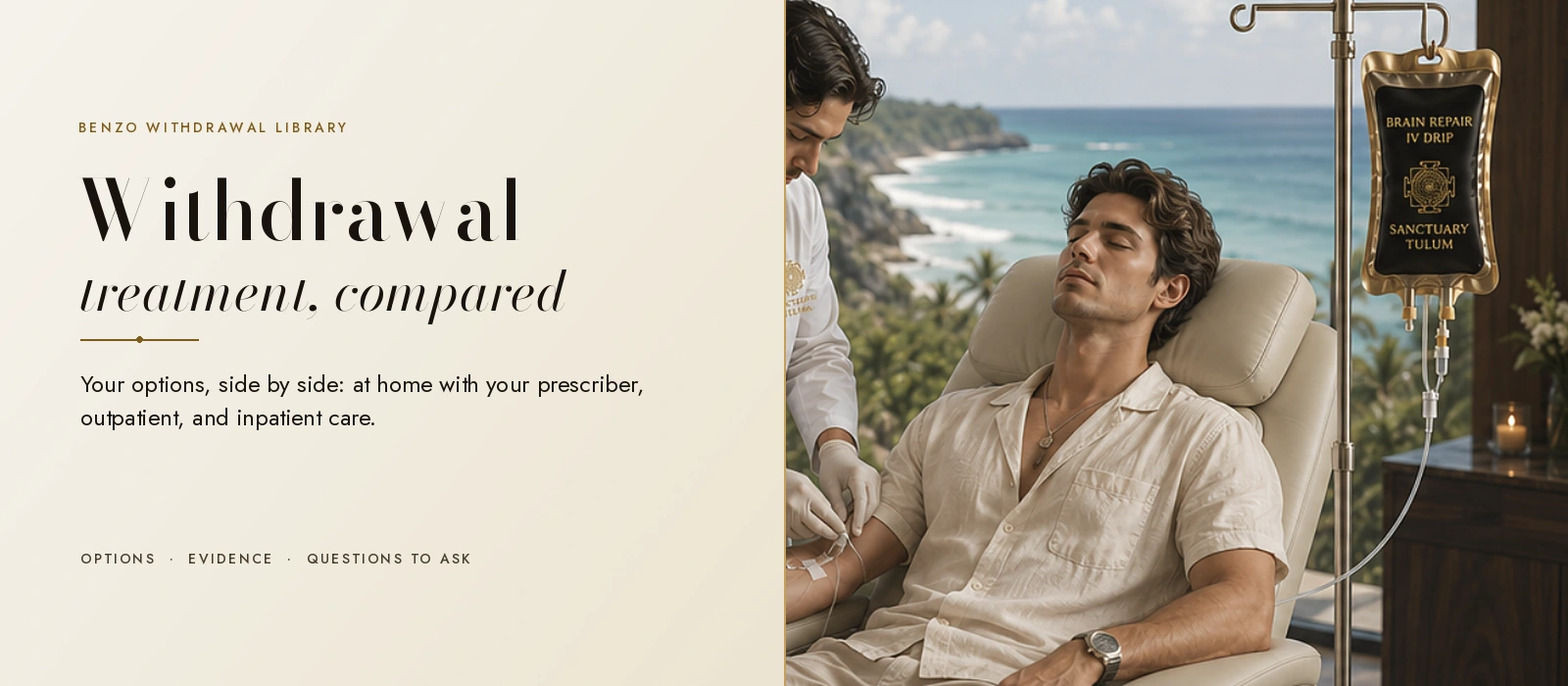
Depending on the person, the program can include the Brain Repair IV Drip, a proprietary formulation incorporating amino acids, peptides, and a nature-derived alkaloid. It is one component of a comprehensive, individualized protocol, intended to support the body and brain during recovery, not presented as a guaranteed cure. Other elements can include nutrition and superfoods, red light therapy, a hyperbaric chamber, infrared sauna and detox baths. Not every guest receives every therapy.
Screening before arrival can include bloodwork, an EKG and blood pressure. In fifteen years, no guest has had a seizure here. That is a statement about the past, not a promise about the future, and safety comes first in every decision.
You can read how the 12-week program at our benzo detox center works.
Questions about benzodiazepine withdrawal treatment
What is the best treatment for benzodiazepine withdrawal?
A gradual taper, adjusted to how you respond, is the foundation. The 2025 joint guideline suggests starting with 5 to 10 percent reductions every two to four weeks. Therapy and practical support for sleep and anxiety can help alongside it.
Can I taper at home?
Many people do, with their own prescriber and a slow plan. More support may help if you have tried more than once and had to go back up, take several medications, or have little support at home.
When is inpatient treatment a good idea?
When closer monitoring is needed: high doses, other medications or alcohol in the picture, medical conditions that raise risk, or repeated unsuccessful attempts at home.
Is there a medication that stops withdrawal?
No medication replaces a slow taper. Clinicians sometimes use medications for specific symptoms, and reversal agents such as flumazenil are advised against for this purpose.
How long does treatment take?
It depends on the dose, the drug and how long you have taken it. People who have used benzodiazepines for years may need a year or more to taper. Residential programs vary; ours usually runs about twelve weeks.
Will I have symptoms even with good treatment?
You may. Nobody can honestly promise a symptom-free withdrawal. A slow, well-supported taper is intended to keep symptoms as manageable as possible.
Sources
- FDA Drug Safety Communication: Boxed Warning for the benzodiazepine class (2020)
- Joint Clinical Practice Guideline on Benzodiazepine Tapering, Journal of General Internal Medicine (2025)
- American Society of Addiction Medicine. New tapering guideline announcement (2025)
- Ashton CH. Benzodiazepines: How They Work and How to Withdraw (The Ashton Manual)
- NHS Scotland. Benzodiazepines and Z-drugs: discontinuation and withdrawal symptoms
- Ashton CH. Reasons for a diazepam (Valium) taper
- Ashton CH. Protracted withdrawal syndromes from benzodiazepines