Benzodiazepine Dependence: Why It Happens, How to Recognize It, and How to Come Off Safely

In brief. Benzodiazepine dependence means the brain has adapted to the medication, so lowering or stopping it brings on withdrawal symptoms. The FDA notes it can develop after several days to weeks of regular use, even when the medication is taken exactly as prescribed.[1] Dependence is not the same as addiction. The safest way off is a gradual taper planned with a clinician, typically starting with reductions of 5 to 10 percent every two to four weeks.[2]
What benzodiazepine dependence is
Benzodiazepines such as Xanax (alprazolam), Ativan (lorazepam), Klonopin (clonazepam), Valium (diazepam) and Restoril (temazepam) work by strengthening GABA, the brain's main calming signal. Each has its own withdrawal pattern; Xanax withdrawal, for example, can begin within hours.
That is why they settle panic and bring on sleep so quickly.
But the brain is always seeking balance. When a benzodiazepine is present every day, the nervous system gradually adjusts its own calming and alerting systems around it. Over time, the medication stops being something extra. It becomes part of how the brain keeps its baseline.
That adjustment is what physical dependence means. Professor Heather Ashton, who ran a benzodiazepine withdrawal clinic for many years, described it in people taking ordinary prescribed doses and called it therapeutic dose dependence.[3]
Dependence shows itself most clearly when the dose drops. Remove the medication, and the adapted brain is suddenly working without the support it has come to expect. The result is withdrawal: anxiety, insomnia, tremor, a racing heart and many other symptoms.[4]
Many of the people I have worked with were simply following their prescription. None of them did anything wrong. Their nervous systems did exactly what nervous systems do.
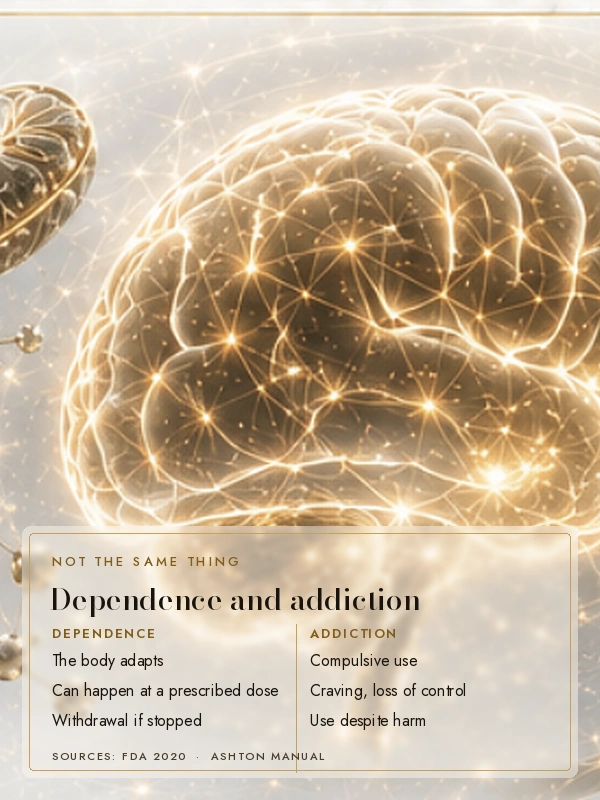
Dependence vs addiction: not the same thing
These two words are often used as if they mean the same thing. They do not, and the difference matters, both for how you see yourself and for how you are treated.
Physical dependence is the body adapting to a medication. It can happen to anyone who takes a benzodiazepine regularly, at a prescribed dose, for legitimate reasons. The 2025 joint guideline on tapering was written largely for this group: adults taking benzodiazepines regularly who may be physically dependent and at risk of withdrawal.[2][5]
Addiction describes a pattern of behavior: compulsive use, craving, loss of control, and continued use despite harm. The FDA's 2020 warning addresses this as a separate risk from physical dependence, alongside misuse and abuse.[1]
A person can be physically dependent without being addicted. Someone can also have both. Neither is a moral failing.
| Physical dependence | Addiction | |
|---|---|---|
| What it is | The nervous system adapting to the drug | A compulsive pattern of use |
| Can it happen at prescribed doses? | Yes, commonly | Less often, but it can |
| Main sign | Withdrawal symptoms when the dose drops | Craving, loss of control, use despite harm |
| Taking more than prescribed | Not part of it | Often part of it |
| What helps | A slow, individualized taper | A taper plus treatment for the behavior itself |
The distinction changes the conversation. A person who is dependent but not addicted does not need to be treated with suspicion. They need a careful plan, time, and a clinician who understands that the symptoms are real.
It also explains why stopping is so hard even for people with no history of misuse. The barrier is not willpower. It is physiology.
In fifteen years of this work, I have seen how much shame people carry when they first realize they are dependent. Much of it comes from a word that does not describe them. Putting it down is often the first real step toward coming off.
Signs your body has adapted

Dependence is often quiet. Many people only notice it when they miss a dose, run out, or try to cut back. These are the signs most often described:[3][4]
- You need it to feel normal. The medication no longer lifts you above baseline. It keeps you at baseline.
- Symptoms appear between doses. Anxiety, restlessness or a racing heart in the hours before the next dose is due. With short-acting benzodiazepines this has been documented in prescribing information as interdose symptoms.[6] Our guide to interdose withdrawal explains why it happens.
- The same dose does less. Sleep or calm is harder to reach than it was at the start. That is tolerance, and it often travels with dependence. See benzo tolerance.
- A late or missed dose is felt. Sleeplessness, shakiness, irritability or a sense of dread when a dose is delayed.
- Anxiety rises despite the medication. Professor Ashton observed that, for some long-term users, anxiety gradually increases over time even while the medication continues.[3]
- Attempts to cut back have not held. You tried to lower the dose and returned to it because the symptoms were too much.
None of these signs means you should stop. They mean your nervous system has adapted, and that any change should be planned.
How quickly benzodiazepine dependence can develop
Faster than most people are told.
The FDA states that physical dependence can develop when benzodiazepines are taken steadily for several days to weeks, even as prescribed.[1] The announcement of the 2025 tapering guideline describes long-term use as typically more than four weeks.[5]
Tolerance moves on a similar clock. Professor Ashton described tolerance to the sleep-promoting effects developing within days to weeks, and to the anti-anxiety effects over months.[3]
Several things can influence how strongly dependence develops:
- Dose. Higher doses are generally harder to come off.
- Duration. The longer the use, the deeper the adaptation tends to be. People who have taken benzodiazepines for years may need to taper for a year or more.[5]
- Potency and half-life. Professor Ashton observed that potent benzodiazepines with short half-lives, including alprazolam and lorazepam, appear to carry the highest risk of dependence problems.[7] Alprazolam has a half-life of roughly 6 to 12 hours, compared with 20 to 100 hours for diazepam.[8]
- Other substances. Alcohol, sleep medications and other sedatives can add to the effect.
None of this is a reason to panic if you have been taking a benzodiazepine for a while. It is a reason to treat any change in dose with respect, and to plan it with someone who understands how these medications work.
Why you shouldn't stop suddenly
When someone realizes they are dependent, the first instinct is often to stop at once. That instinct is understandable. It is also the most dangerous option.
In 2020 the FDA required its strongest warning, the Boxed Warning, on every benzodiazepine. It states that abrupt discontinuation or rapid dose reduction can cause withdrawal reactions, including seizures, which can be life-threatening.[1]
Even when stopping suddenly is not dangerous in that way, it tends to make withdrawal harder. Professor Ashton observed that people who develop severe symptoms have usually come off too rapidly.[3]
A minority of people experience symptoms that continue for months after stopping. NHS guidance estimates this may affect up to 15 percent of people.[9] A gradual taper is the best-supported way to reduce that risk.
If you have run out, or you are thinking about stopping, speak to your prescriber first.
Coming off safely
Physical dependence is very treatable. The method is simple to describe and requires patience to carry out: bring the dose down slowly enough that the brain can readjust at each step.
The 2025 joint guideline from the American Society of Addiction Medicine and partner organizations recommends:[2][5]
- Starting with reductions of about 5 to 10 percent of the daily dose every two to four weeks.
- Generally not exceeding 25 percent every two weeks.
- Adjusting the pace to how you respond, including pausing when needed.
- Making the plan together, with your preferences part of the decision.
For people on short-acting benzodiazepines, some prescribers switch to a longer-acting one such as diazepam before tapering, to smooth out the drops between doses.[10] Whether that suits you is a decision for your prescriber.
Many people come off successfully at home this way, with their own clinician. Our guide to benzodiazepine withdrawal treatment compares home, outpatient and inpatient options side by side.
When you need more support
Some people find that, despite a careful plan, the symptoms outrun daily life. Sleep collapses. Work and family suffer. They go back up, and try again, and go back up.
At Benzo Detox Protocol, the benzo program is built for people who could not get off at home, or who tried a detox and went back up. It is medically supervised, and most guests stay about twelve weeks; harder cases can take longer. The taper is paced individually by the medical team, with around nine hours a day of one-to-one care, 24-hour nursing and private suites. There is no group therapy.
Alongside the taper, depending on the person, care can include the Brain Repair IV Drip, a proprietary formulation incorporating amino acids, peptides, and a nature-derived alkaloid. It is one component of a comprehensive, individualized protocol, intended to support the body and brain during recovery, not presented as a guaranteed cure. Nutrition and superfoods, red light therapy, a hyperbaric chamber, infrared sauna and detox baths may also be part of the plan. Not every guest receives every therapy.
Screening before arrival can include bloodwork, an EKG and blood pressure. In fifteen years, no guest has had a seizure here. That is a record of the past, not a guarantee, and safety comes first in every decision. See how the 12-week program at our benzo detox center works.
Questions about benzodiazepine dependence
Can you become dependent on benzos taken as prescribed?
Yes. The FDA notes that physical dependence can develop after several days to weeks of regular use, even at prescribed doses. It reflects how the brain adapts, not how the medication was used.
Is benzodiazepine dependence the same as addiction?
No. Dependence is the body adapting, shown by withdrawal when the dose drops. Addiction is a compulsive pattern of use despite harm. A person can have one without the other.
How do I know if I am dependent?
Common signs include needing the medication to feel normal, symptoms between doses, the same dose doing less, and feeling unwell when a dose is late. Talk to your prescriber about what you notice.
How long does it take to become dependent?
It varies, but it can be a matter of weeks. Dose, duration and the type of benzodiazepine all play a part.
Can I stop on my own?
Please don't stop suddenly. Abrupt discontinuation can cause seizures. Plan a gradual taper with your prescriber.
Does dependence go away after tapering?
For most people the nervous system readjusts once the medication is gone. A minority have symptoms that last months, which is one more reason to taper slowly.
Sources
- FDA Drug Safety Communication: Boxed Warning for the benzodiazepine class (2020)
- Joint Clinical Practice Guideline on Benzodiazepine Tapering, Journal of General Internal Medicine (2025)
- Ashton CH. Benzodiazepines: How They Work and How to Withdraw (The Ashton Manual)
- Ashton CH. Benzodiazepine dependence and withdrawal: an update (1985)
- American Society of Addiction Medicine. New tapering guideline announcement (2025)
- Alprazolam prescribing information: interdose symptoms
- Ashton CH. Guidelines for the rational use of benzodiazepines
- Ashton CH. Benzodiazepine Equivalence Table
- NHS Scotland. Benzodiazepines and Z-drugs: discontinuation and withdrawal symptoms
- Ashton CH. Reasons for a diazepam (Valium) taper