Xanax Withdrawal: Why It Starts So Fast, What It Feels Like, and How to Come Off Safely

In brief. Xanax (alprazolam) is a potent, short-acting benzodiazepine. After regular use the brain adapts to it, and because it is short-acting, withdrawal can begin quickly after a missed or reduced dose. Symptoms often include rebound anxiety, insomnia, tremor and a racing heart; seizures are the most serious risk, and the prescribing information notes they seemed most likely 24 to 72 hours after stopping.[1][3][4] The safest path is a slow, individualized taper set with a clinician, usually starting with reductions of 5 to 10 percent every two to four weeks.[6]
Why Xanax withdrawal starts so fast
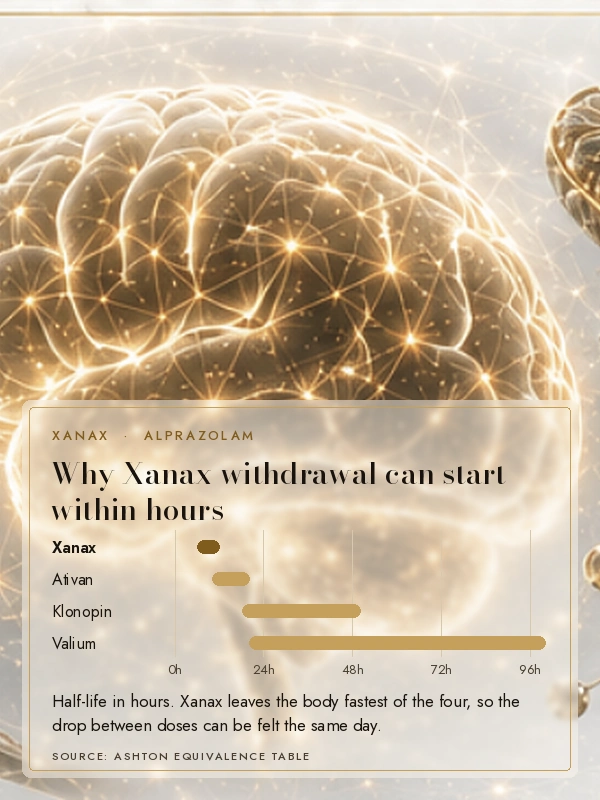
Xanax works by strengthening GABA, the brain's main calming signal. That is why it can quiet a panic attack within minutes.
Taken steadily, the brain adjusts. It turns down its own calming system, because the medication is doing part of the work. The FDA notes that physical dependence can develop after several days to weeks of regular use, even when the medication is taken exactly as prescribed.[1]
Dependence is not addiction, and it is not a character flaw. It is how the nervous system responds to the drug. Many of the people I have worked with were simply following their prescription.
Three properties make Xanax withdrawal different from most other benzodiazepines.
It leaves the body quickly. Its half-life is roughly 6 to 12 hours, according to the equivalence table developed by Professor Heather Ashton of Newcastle University.[2] It also has no long-acting byproducts to cushion the drop. By the time the next dose is due, blood levels can already be falling.
It is potent. About 0.5 mg of alprazolam is roughly equivalent to 10 mg of diazepam (Valium).[2] A cut that looks small in milligrams can be a large change for the brain.
It is often taken as needed. Many people take Xanax on and off, around flights, meetings or bad nights. That pattern can mean the brain is in a small cycle of relief and withdrawal several times a week without the person realizing it.
Professor Ashton observed that potent benzodiazepines with short half-lives, including alprazolam and lorazepam, appear to carry the highest risk of dependence problems.[5]
Tolerance adds to the picture. The Ashton Manual describes tolerance to the sleep-promoting effects developing within days to weeks, and to the anti-anxiety effects over months.[8] Some people find the same dose no longer covers the day, which is often the first quiet sign of withdrawal.
Extended-release Xanax XR releases the medication more slowly through the day, which can smooth the peaks and troughs. It is still alprazolam, and stopping it suddenly carries the same warnings.[1]
Xanax withdrawal symptoms, body and mind
Not everyone has every symptom, and none of them is inevitable. These are the ones most often described:[4][8]
| Mind | Body | Senses |
|---|---|---|
| Anxiety and panic, sometimes stronger than before | Insomnia and broken sleep | Sensitivity to light, sound and touch |
| Racing thoughts, irritability, restlessness | Tremor, muscle tension and aches | Tingling or pins and needles |
| Poor concentration and memory | Racing heart, palpitations, sweating | Dizziness, blurred vision |
| Low mood, feelings of unreality | Nausea, stomach upset, appetite change | Altered taste and smell |
The anxiety deserves its own mention. Withdrawal anxiety can feel identical to the condition Xanax was first prescribed for, only stronger. It is easy to read that as proof you still need the medication. Often it is the withdrawal itself.
The most serious risks are seizures, severe confusion and hallucinations. NHS guidance describes these as rare and usually linked to rapid withdrawal from high doses.[4] The Xanax prescribing information describes withdrawal seizures, and notes that the risk and severity of dependence appear greater at doses above 4 mg a day and with use for more than twelve weeks.[3]
Our separate guide to benzo withdrawal seizures covers who is most at risk and what to do if one happens.
If withdrawal brings thoughts of suicide or self-harm, call or text 988, the Suicide and Crisis Lifeline, at any hour.
The Xanax withdrawal timeline, hour by hour then week by week

There is no single timeline. Dose, length of use, other medications and above all the speed of reduction all change it. As a general guide:
- The first hours. Because alprazolam has a short half-life, some people notice early symptoms within hours of a missed or reduced dose: an edge of anxiety, restlessness, a tight chest.[2][4]
- Days one to three. If the medication has been stopped suddenly, this is often the hardest stretch. Anxiety, sleeplessness and tremor can build. The prescribing information notes that seizure risk seemed greatest 24 to 72 hours after discontinuation.[3]
- The first weeks. Acute symptoms are usually most intense early and then ease, especially with a gradual taper. Sleep and anxiety tend to be the slowest to settle.
- Months. A minority of people have symptoms that last much longer. Professor Ashton estimated this may affect perhaps 10 to 15 percent of long-term users, and NHS guidance gives a figure of up to 15 percent.[8][4] NHS guidance notes that protracted anxiety can gradually recede over a year, and insomnia over six to twelve months.[4]
A 2023 survey of people who had taken benzodiazepines, published in PLOS ONE, described symptoms that for some persisted long after the medication was stopped.[10] The FDA has also noted withdrawal symptoms lasting many months in some patients.[1]
That is not said to frighten anyone. Most people recover, and Professor Ashton described lingering symptoms as improving gradually over many months.[9] It is said so that nobody is told their withdrawal should be over by a certain date and then blames themselves when it is not.
On a slow taper the timeline looks different again. Instead of one sharp drop, there is a series of small adjustments, each with a few unsettled days before the body levels out.
For a week-by-week view across all the common benzodiazepines, see the benzo withdrawal timeline.
Interdose and rebound anxiety
Some people feel withdrawal while still taking Xanax every day.
The prescribing information records that early morning anxiety, and anxiety emerging between doses, have been reported in people taking alprazolam for panic disorder.[3] This is called interdose withdrawal. The level of medication falls between doses, and the brain registers the drop.
It can look like this:
- Waking with a racing heart or a sense of dread that eases after the first dose.
- Anxiety that rises in the late afternoon, in a predictable pattern.
- Watching the clock for the next dose.
Rebound anxiety is related. It is a return of anxiety, often stronger than the original, when the dose is cut or stopped.
Both are signs that the medication's short action is part of the problem. Our guide to interdose withdrawal explains the pattern in more depth.
Why not stop Xanax all at once
In 2020 the FDA required its strongest warning, the Boxed Warning, on every benzodiazepine. It states that abrupt discontinuation or rapid dose reduction can cause withdrawal reactions, including seizures, which can be life-threatening.[1]
With Xanax that warning carries particular weight, because the drop in blood levels after a sudden stop is so fast.
People stop suddenly for understandable reasons. A prescription runs out. A doctor retires. Someone decides they are done and wants it over with. If that is where you are, read what happens when you stop Xanax cold turkey before you do anything else, and speak with a clinician the same day.
Tapering Xanax, and why it stalls
In 2025, the American Society of Addiction Medicine and nine other medical organizations published a joint guideline on benzodiazepine tapering. Its recommendations are measured and humane:[6][7]
- Start slowly, usually with reductions of 5 to 10 percent of the daily dose every two to four weeks.
- Generally do not exceed 25 percent every two weeks.
- Adjust the pace to how the person responds. Pausing is allowed.
- Make the plan together, with the patient's preferences in the room.
Xanax tapers often go well at first and then stall. There are a few reasons.
The steps get harder to make small. Tablets come in fixed strengths. As the dose falls, a single quarter-tablet becomes a large share of what is left, and the last steps can feel like the biggest.
The short half-life works against steady levels. Even on a stable dose, blood levels rise and fall through the day. Each reduction can make those dips sharper.
Withdrawal anxiety is mistaken for relapse. When anxiety rises, it is natural to conclude the taper is failing. Often the right response is to pause, not to reverse.
Clinicians have several ways to work with this. Some divide the daily dose into more frequent, smaller doses. Some use smaller tablet strengths or other preparations to make finer cuts. And some switch the person to a long-acting benzodiazepine such as diazepam before tapering. Professor Ashton described this switch because diazepam produces a smoother fall in blood levels and allows small, steady reductions.[11]
Each of these is a decision for your prescriber. Our Xanax taper schedule lays out a sample plan to discuss with them, and switching to Valium to taper explains the crossover in more detail.
Done slowly, many people find tapering far more manageable than they feared. Professor Ashton observed that people who develop severe symptoms have usually come off too rapidly.[8]
Treatment options
Many people come off Xanax with their own prescriber, at home, on a slow taper. That is often the right place to start. When home tapering is not enough, inpatient benzo detox offers care around the clock.
Other people need more support. Signs that you may be one of them:
- You have tried to taper more than once and had to go back up.
- You are sleeping only a few hours a night for weeks at a time.
- You take more than one sedating medication, or drink alongside Xanax.
- Work, family or your own safety is suffering.
At Benzo Detox Protocol, the benzo program is built for people who could not get off at home, or who tried a detox and went back up. Most guests stay about twelve weeks; harder cases can take longer.
Screening before arrival can include bloodwork, an EKG and blood pressure. The taper is medically supervised and paced individually by the medical team, with 24-hour nursing, private suites and around nine hours a day of one-to-one care. There is no group therapy.
Alongside the taper, depending on the person, care can include the Brain Repair IV Drip, a proprietary formulation incorporating amino acids, peptides, and a nature-derived alkaloid. It is one component of a comprehensive, individualized protocol, intended to support the body and brain during recovery, not presented as a guaranteed cure. Nutrition and superfoods, red light therapy, the hyperbaric chamber, infrared sauna and detox baths may also be part of the plan. Not every guest receives every therapy.
In fifteen years, no guest has had a seizure here. That is a record of the past, not a promise about the future, and safety comes first in every taper.
See how the 12-week program at our benzo detox center works.
Questions about Xanax withdrawal
How long does Xanax withdrawal last?
Acute symptoms usually ease over several weeks, especially on a slow taper. A minority of people, perhaps 10 to 15 percent of long-term users, have symptoms that last months. Dose, length of use and taper speed all matter.
How soon does Xanax withdrawal start?
Because alprazolam has a half-life of roughly 6 to 12 hours, symptoms can begin within hours of a missed or reduced dose. After a sudden stop, the prescribing information notes seizure risk seemed greatest at 24 to 72 hours.
Is Xanax withdrawal dangerous?
It can be. Stopping suddenly or cutting quickly can cause seizures, which can be life-threatening. A gradual, individualized taper greatly lowers that risk.
What are the first signs of Xanax withdrawal?
Often rising anxiety, restlessness, poor sleep and a racing heart. Some people first notice anxiety in the early morning or between doses.
How fast should I taper off Xanax?
The 2025 joint guideline suggests starting with 5 to 10 percent reductions every two to four weeks, generally no more than 25 percent every two weeks, adjusted to how you respond. Your prescriber should set the pace.
Can I switch from Xanax to Valium to taper?
Some clinicians do this because diazepam is long-acting and allows smoother, smaller steps. It should only be done under a clinician's guidance.
Sources
- FDA Drug Safety Communication: Boxed Warning for the benzodiazepine class (2020)
- Ashton CH. Benzodiazepine Equivalence Table
- Alprazolam prescribing information: drug abuse, dependence and withdrawal
- NHS Scotland. Benzodiazepines and Z-drugs: discontinuation and withdrawal symptoms
- Ashton CH. Guidelines for the rational use of benzodiazepines
- Joint Clinical Practice Guideline on Benzodiazepine Tapering, Journal of General Internal Medicine (2025)
- American Society of Addiction Medicine. New tapering guideline announcement (2025)
- Ashton CH. Benzodiazepines: How They Work and How to Withdraw (The Ashton Manual)
- Ashton CH. Protracted withdrawal syndromes from benzodiazepines
- Ritvo AD et al. Long-term consequences of benzodiazepine-induced neurological dysfunction: a survey. PLOS ONE (2023)
- Ashton CH. Reasons for a diazepam (Valium) taper