Xanax Taper Schedule: How to Come Off Xanax Step by Step, at a Pace Your Body Can Follow

In brief. Xanax (alprazolam) is potent and short-acting, so the dose needs to come down slowly. The 2025 joint guideline on benzodiazepine tapering recommends starting with reductions of 5 to 10 percent every two to four weeks, generally not more than 25 percent every two weeks, adjusted to how you respond, with pauses allowed.[2][3] The steps get smaller as the dose falls, which is why the end of a Xanax taper often takes the longest. Any schedule should be set with your prescriber, never on your own.[1]
The rule of thumb: 5 to 10 percent every 2 to 4 weeks

In 2025, the American Society of Addiction Medicine and partner medical societies published a joint clinical practice guideline on benzodiazepine tapering.[2][3]
Its central advice is simple and humane.
- Start with small reductions, usually 5 to 10 percent of the total daily dose every two to four weeks.
- Generally do not exceed 25 percent every two weeks.
- Watch closely for withdrawal after each step, and adjust the pace to how you respond.
- A pause is allowed when you need one.
- Make the plan together, with your preferences in the room.
The guideline also acknowledges that people who have taken a benzodiazepine for a long time may need a year or more to finish.[3]
That can be hard to hear. It is also the reason so many slow tapers succeed where fast ones failed.
Two features of alprazolam make the slow approach especially important. It is potent: about 0.5 mg is roughly equivalent to 10 mg of diazepam (Valium), according to the equivalence table developed by Professor Heather Ashton of Newcastle University.[4] And it leaves the body quickly, with a half-life of roughly 6 to 12 hours.[4]
Professor Ashton observed that potent benzodiazepines with short half-lives, alprazolam among them, appear to carry the highest risk of dependence problems.[9]
A quarter of a milligram of Xanax sounds small. For the brain, it is a meaningful change.
A sample schedule (for discussion with your prescriber)
The table below is an illustration only. It is not a prescription, and it is not a plan to follow on your own.
It shows what the guideline's numbers can look like for one hypothetical person taking 2 mg of alprazolam a day, using steps of 0.125 mg, which is half of a 0.25 mg tablet. Your prescriber may choose a different starting point, a different step size, or a slower pace.
| Step | Total daily dose | Reduction | Share of current dose | Hold before next step |
|---|---|---|---|---|
| Start | 2.0 mg | — | — | — |
| 1 | 1.875 mg | 0.125 mg | about 6% | 2 to 4 weeks |
| 2 | 1.75 mg | 0.125 mg | about 7% | 2 to 4 weeks |
| 3 | 1.625 mg | 0.125 mg | about 7% | 2 to 4 weeks |
| 4 | 1.5 mg | 0.125 mg | about 8% | 2 to 4 weeks |
| 5 | 1.375 mg | 0.125 mg | about 8% | 2 to 4 weeks |
| 6 | 1.25 mg | 0.125 mg | about 9% | 2 to 4 weeks |
| 7 | 1.125 mg | 0.125 mg | 10% | 2 to 4 weeks |
| Below this | A 0.125 mg step would now be more than 10 percent of the dose. Smaller steps need a liquid form, a compounded dose, or a switch to a longer-acting benzodiazepine. | |||
Illustration only, to discuss with your prescriber. Based on the 2025 joint guideline: start with 5 to 10 percent reductions every two to four weeks, generally no more than 25 percent every two weeks, with pauses as needed.[2] Do not use this table to change your own dose.
Notice what the table shows. Seven careful steps, held for two to four weeks each, take roughly three and a half to six and a half months and bring the dose to just over half.
That is not a failure of the schedule. It is how a safe Xanax taper is meant to look.
When the daily dose is split across the day, the guideline suggests deciding which dose to reduce first by what troubles you most. If sleep is the main concern, for example, a clinician may reduce an earlier dose and leave the night dose for later.[2]
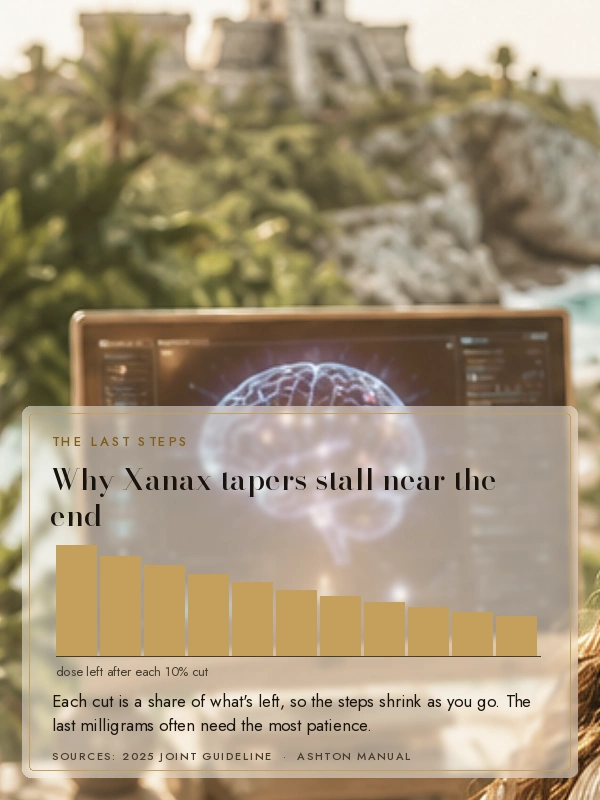
Why Xanax tapers stall near the end
Many people move through the first half of a taper and then find that each step suddenly feels larger.
Part of the reason is arithmetic. A fixed step of 0.125 mg is about 6 percent of 2 mg, but it is 25 percent of 0.5 mg and half of 0.25 mg. The same tablet fraction becomes a much bigger share of what the brain is used to.
That is why the guideline frames reductions as a percentage of the dose rather than a fixed amount.[2] As the dose falls, the steps should shrink with it.
The other reason is the drug itself. Because alprazolam leaves the body quickly, some people notice symptoms returning between doses, often in the early morning. The alprazolam prescribing information describes this kind of early-morning anxiety and anxiety emerging between doses.[6]
We explain this in more depth in our guide to interdose withdrawal between Xanax doses.
When interdose symptoms and larger percentage steps arrive together, a taper can feel as if it has hit a wall. It usually has not. It usually needs smaller steps, a slower pace, or a different form of the medication.
Liquid and split doses
Alprazolam tablets come in 0.25, 0.5, 1 and 2 mg strengths.[6] Below about 1 mg a day, a 5 to 10 percent step is smaller than half of the smallest tablet.
Prescribers and pharmacists handle this in a few ways:
- Splitting the day differently. Spreading the same total over more doses can soften the dips between them.
- A liquid form. A measured liquid allows very small, precise reductions. Availability varies, and the measuring method matters.
- A compounded dose. Some pharmacies can prepare tablets or capsules in custom strengths.
Please do not attempt to make a liquid or shave tablets at home without your prescriber and pharmacist. Small measurement errors can mean large changes in dose.
Switching to a longer-acting benzo
The other common approach is to replace Xanax with a long-acting benzodiazepine, most often Valium (diazepam), and then taper that instead.
Professor Ashton recommended this for many people coming off potent, short-acting benzodiazepines such as alprazolam.[7] Diazepam leaves the body slowly, with a half-life of roughly 20 to 100 hours and an active metabolite that lasts far longer.[4] Its 2 mg tablets can be halved, allowing reductions of 1 mg at a time.[7]
Using the Ashton table, 2 mg of alprazolam corresponds to roughly 40 mg of diazepam.[4] These equivalents are approximate, and people respond differently, so the switch is made gradually, one dose at a time, with adjustments along the way.[7]
A switch is not right for everyone. Older adults and people with liver problems need particular care with diazepam. Our full guide to switching to Valium to taper walks through how the crossover works, who it suits, and who it does not.
Whether to taper alprazolam directly or switch first is a decision for you and your prescriber together.
When to pause
The guideline is clear that the pace should follow the person, not the calendar. Pausing at a dose is a normal part of tapering, not a step backward.[2]
It is reasonable to ask your prescriber about holding at your current dose when:
- Sleep has dropped to a few hours a night and is not recovering.
- Anxiety, tremor or physical symptoms are building rather than settling after a step.
- A major life event, illness or loss is happening at the same time.
- You simply need time for your body to catch up.
Some situations call for faster help. New confusion, hallucinations, a seizure, or thoughts of harming yourself are not reasons to wait for the next appointment. Call 911, or call or text 988 for the Suicide and Crisis Lifeline.
The FDA's Boxed Warning, added to every benzodiazepine in 2020, states that stopping suddenly or reducing the dose too quickly can cause withdrawal reactions, including seizures, which can be life-threatening.[1] Professor Ashton observed that people who develop severe symptoms have usually come off too quickly.[5]
A minority of people continue to have symptoms for months after stopping. NHS Scotland guidance estimates this may affect up to 15 percent of people.[8] A slower, steadier taper is one of the few things that can reduce the strain along the way.
The guideline also recommends offering supportive therapy, such as cognitive behavioral therapy, alongside the taper.[2] A randomized trial in older adults found that adding cognitive behavioral therapy to gradual tapering helped considerably more people stay off benzodiazepines than tapering alone.[10]
When tapering at home is not enough
Many of the people I have worked with were simply following their prescription. They tried to come off responsibly, sometimes more than once, and found that the symptoms outran daily life.
At Benzo Detox Protocol, the benzo program is built for people who could not get off at home, or who tried a detox and went back up. Most guests stay about twelve weeks; harder cases can take longer. There are around nine hours a day of one-to-one care, 24-hour nursing and private suites, and no group therapy.
The taper is medically supervised and paced individually by the medical team. Alongside it, depending on the person, care can include the Brain Repair IV Drip, a proprietary formulation incorporating amino acids, peptides, and a nature-derived alkaloid. It is one component of a comprehensive, individualized protocol, intended to support the body and brain during recovery, not presented as a guaranteed cure. Nutrition and superfoods, red light therapy, the hyperbaric chamber, infrared sauna and detox baths may also be part of the plan.
Screening before arrival can include bloodwork, an EKG and blood pressure. In fifteen years, no guest has had a seizure here. That is a record of the past, not a promise, and safety comes first in every taper.
You can read how our 12-week benzo detox program works, or return to the main guide to Xanax withdrawal symptoms and timeline.
Questions about a Xanax taper schedule
How fast should I taper off Xanax?
The 2025 joint guideline suggests starting with reductions of 5 to 10 percent of the daily dose every two to four weeks, generally not more than 25 percent every two weeks, adjusted to how you respond. Your prescriber should set the pace with you.
How long does a Xanax taper take?
It varies widely. After long-term use, a taper can take many months, and sometimes a year or more. The final steps often take the longest because they need to be smallest.
Can I make my own Xanax taper chart?
Please don't change your dose without your prescriber. A chart like the illustration on this page is useful for a conversation with your clinician, not as a plan to follow alone.
Is it better to switch to Valium to taper?
For some people it can make the taper smoother, because diazepam leaves the body slowly and allows small steps. It is not right for everyone, and the switch itself must be done gradually under a clinician's guidance.
Is it normal to feel worse near the end?
Many people find the last steps the hardest, partly because each step is a bigger share of a small dose. Smaller steps, a pause, or a different form of the medication can help.
Can I stop Xanax cold turkey if my dose is low?
Stopping suddenly can be dangerous even at lower doses after regular use. The FDA warns that abrupt discontinuation can cause life-threatening withdrawal reactions, including seizures.
Sources
- FDA Drug Safety Communication: Boxed Warning for the benzodiazepine class (2020)
- Joint Clinical Practice Guideline on Benzodiazepine Tapering, Journal of General Internal Medicine (2025)
- American Society of Addiction Medicine. New tapering guideline announcement (2025)
- Ashton CH. Benzodiazepine Equivalence Table
- Ashton CH. Benzodiazepines: How They Work and How to Withdraw (The Ashton Manual)
- Alprazolam tablets: prescribing information
- Ashton CH. Reasons for a diazepam (Valium) taper
- NHS Scotland. Benzodiazepines and Z-drugs: discontinuation and withdrawal symptoms
- Ashton CH. Guidelines for the rational use of benzodiazepines
- Baillargeon L et al. Discontinuation of benzodiazepines among older insomniac adults treated with cognitive-behavioural therapy combined with gradual tapering: a randomized trial. CMAJ (2003)