Interdose Withdrawal: Why You Feel Worse Between Doses
In brief. Interdose withdrawal is when withdrawal-like symptoms, such as anxiety, tension and restlessness, return in the hours before your next benzodiazepine dose, even though you are taking it exactly as prescribed. It is most common with short-acting drugs like Xanax. The prescribing information for alprazolam describes it directly. It is a sign the body has adapted to the medication, and it is worth raising with your prescriber rather than managing alone.[1][2]
What interdose withdrawal is
You take your dose. It works. A few hours later, the anxiety creeps back, your muscles tighten, and you start watching the clock until the next one.
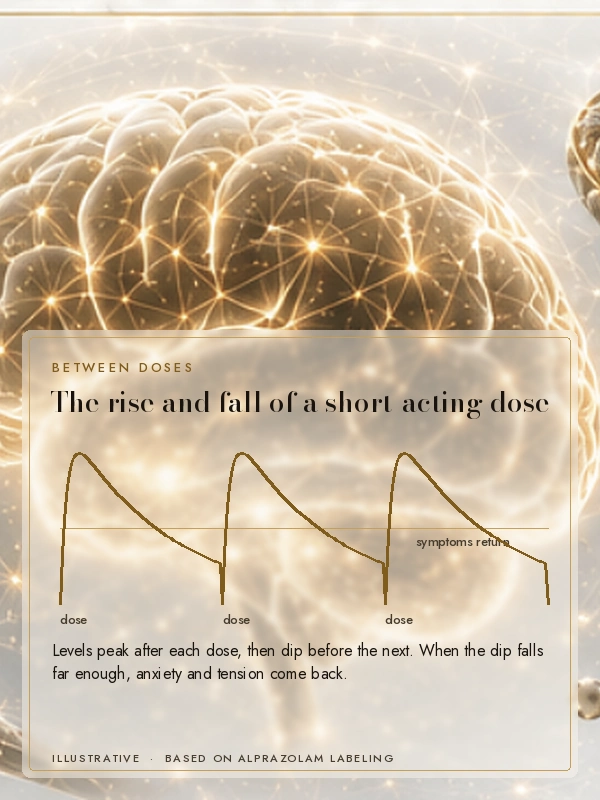
That pattern has a name. The official prescribing information for alprazolam (Xanax) describes early morning anxiety and anxiety between doses in people taking prescribed maintenance doses. It says these symptoms may reflect tolerance, or a gap between doses longer than the drug's effect.[1]
You are not doing anything wrong. Your body is telling you something about how it has adapted.
The signs of interdose withdrawal
- Anxiety that returns at the same point before each dose
- Waking early with a racing heart or a sense of dread
- Muscle tension, shakiness or restlessness that eases soon after a dose
- Irritability and trouble concentrating late in the dosing interval
- Clock-watching, and planning your day around doses
The giveaway is the rhythm. Symptoms that reliably ease shortly after a dose and return before the next one point toward interdose withdrawal rather than the original anxiety.
Why it happens
Two things combine.
A short half-life. Xanax has a half-life of roughly 6 to 12 hours.[3] Levels in the blood rise and fall steeply over the day, and the troughs can dip below what the adapted brain now expects.
Tolerance. Over time, the same dose does less. Professor Heather Ashton described long-term users who begin to experience withdrawal symptoms even though they continue taking the drug.[4] She called this pattern clearest with short-acting benzodiazepines, and noted these symptoms are relieved by taking the drug but eventually disappear after it is stopped.[5]
Lorazepam (Ativan), with a half-life of about 10 to 20 hours, can cause the same pattern. Read more in our guide to Ativan withdrawal.
Why it matters
Interdose withdrawal is a signal of physical dependence. Left alone, it often leads to a cycle: earlier doses, extra doses, higher doses, and stronger withdrawal when the dose eventually has to come down.
It is also a reason many people decide it is time to taper. That decision deserves a plan, not a sudden stop.
What clinicians may do

Options your prescriber may consider include:
- Switching to a longer-acting benzodiazepine, such as diazepam, which smooths out the peaks and troughs. Professor Ashton recommended this for long-term users who find it hard to come off short-acting drugs like alprazolam or lorazepam.[6]
- Adjusting the dosing schedule, spreading the same daily amount more evenly, as a short-term bridge.
- Planning a gradual taper. The 2025 joint guideline recommends starting with reductions of 5 to 10 percent every two to four weeks and adjusting to your response.[7]
At Benzo Detox Protocol, our benzo program is medically supervised and one-to-one, and most guests stay around twelve weeks. Our medical team stabilizes the swings first, then paces the taper day by day. In fifteen years, no guest has had a seizure here. See how our benzo detox center works.
What not to do
Questions about interdose withdrawal
Can you have withdrawal while still taking benzos?
Yes. Interdose withdrawal and tolerance withdrawal both describe withdrawal symptoms that appear while someone is still taking their prescribed dose.
Which benzodiazepines cause interdose withdrawal?
It is most common with short-acting drugs like alprazolam (Xanax) and, to a lesser extent, lorazepam (Ativan). Long-acting drugs like diazepam are less likely to cause it.
Does interdose withdrawal mean I'm addicted?
No. It means your body has become physically dependent, which can happen with prescribed use. Dependence and addiction are different things.
Should I increase my dose to stop it?
Not on your own. Talk to your prescriber. Raising the dose often deepens tolerance and makes the eventual taper harder.
Sources
- Alprazolam prescribing information: interdose symptoms
- FDA Drug Safety Communication: Boxed Warning for the benzodiazepine class (2020)
- Ashton CH. Benzodiazepine Equivalence Table
- Ashton CH. The Ashton Manual, chapter 3
- Ashton CH. Protracted withdrawal syndromes from benzodiazepines
- Ashton CH. Footnote to British National Formulary guidance (2013)
- Joint Clinical Practice Guideline on Benzodiazepine Tapering, Journal of General Internal Medicine (2025)
- FDA Drug Safety Podcast: benzodiazepine Boxed Warning