Luxury Benzo Detox: Privacy, Time and One-to-One Care, Built Around One Person at a Time

In brief. At Benzo Detox Protocol, luxury benzo detox means privacy, time and attention: a private oceanfront suite, around nine hours a day of one-to-one care, 24-hour nursing and no group therapy. The comfort serves a purpose. Coming off a benzodiazepine safely is a slow process, and current guidance recommends a gradual, individualized taper rather than a fast one.[1][2] Most guests stay about twelve weeks. Nothing about the setting replaces careful medicine, and nothing about it is a promise of a symptom-free withdrawal.
What luxury means here, and what it doesn't
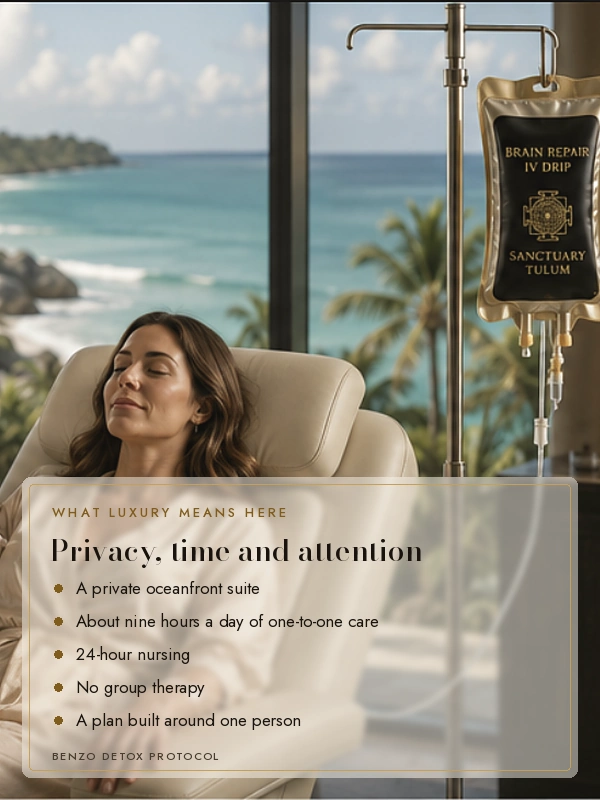
The word luxury is used loosely in this field. It helps to say plainly what we mean by it.
To us, luxury is not marble or thread count. It is time. It is privacy. It is the attention of people who know your history and notice how you slept.
That matters more in benzodiazepine withdrawal than almost anywhere else. With steady use, the brain adapts to the medication, and the FDA warns that stopping suddenly or reducing the dose too quickly can cause serious withdrawal reactions, including seizures.[3] A safe taper is unhurried by design. The 2025 joint guideline from the American Society of Addiction Medicine and nine other organizations recommends starting with reductions of 5 to 10 percent every two to four weeks, adjusted to how the person responds.[1][2]
When a process has to be slow, the setting it happens in matters a great deal. A quiet suite, a calm day and someone close by can make a hard week bearable.
| What luxury means here | What it does not mean |
|---|---|
| A private oceanfront suite | A shared ward or a crowded dormitory |
| Around nine hours a day of one-to-one care | Group sessions with strangers |
| 24-hour nursing | Waiting until morning when a night is hard |
| A taper paced individually by the medical team | A faster detox because the setting is comfortable |
| Care chosen for you after screening | Every therapy for every guest |
| Honesty about what can and cannot be promised | A guarantee of a symptom-free withdrawal |
I will be direct about the last row. No setting, however beautiful, removes the biology of withdrawal. What a setting like ours can offer is support close at hand while the body readjusts.
Privacy and one-to-one care
Many of the people who come to us are used to being responsible for others. Executives, founders, parents, people with public lives. For them, discretion is not a preference. It is a condition of getting help at all.
Each guest has a private suite. Stays are confidential. There is no group therapy, so no one hears your story unless you choose to tell it.
The care itself is one-to-one, around nine hours a day. That time is shaped around you: your history, your energy on a given day, and how you are responding to the taper.
Nursing continues around the clock. Withdrawal does not keep office hours, and a difficult night is often when support matters most.
Before arrival, screening can include bloodwork, an EKG and blood pressure. That gives the medical team a clear picture of your health before the first reduction is planned.
The taper itself is paced by the medical team, individually. It can slow down. It can pause. The 2025 guideline describes pauses as a normal part of a careful taper, not a setback.[1]
This is the difference between a private, residential setting and an appointment every few weeks. If you would like to see the two compared plainly, our guide to inpatient benzo detox sets out who each one tends to suit.
Many of the people I have worked with were simply following their prescription for years. They did nothing wrong. They deserve to come off with dignity, and with the privacy to do it on their own terms.
The Brain Repair IV Drip
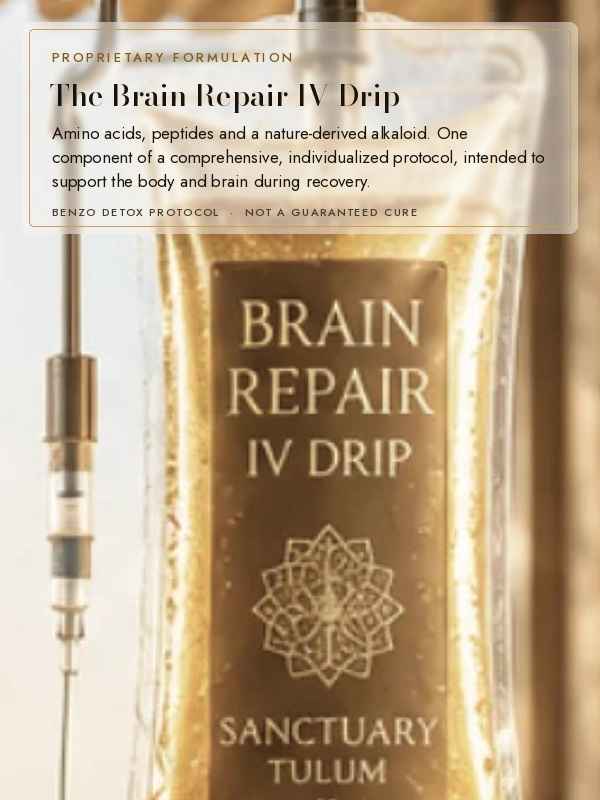
Depending on the person, the plan may include the Brain Repair IV Drip.
It is a proprietary formulation incorporating amino acids, peptides, and a nature-derived alkaloid. It is one component of a comprehensive, individualized protocol, intended to support the body and brain during recovery. It is not presented as a guaranteed cure.
It does not replace the taper. The taper, paced by the medical team, remains the foundation of coming off a benzodiazepine safely.[1]
Whether it is part of your plan, and when, is decided after screening and reviewed as you go.
I am careful with how we describe it, and you should expect the same care from anyone who offers you something similar. A formulation that is part of a wider plan, given by a medical team that is watching how you respond, is a very different thing from a single remedy sold as an answer.
Nutrition, movement and rest
Withdrawal is tiring. Many guests arrive with poor sleep, little appetite and a nervous system that has been on alert for a long time.
Nutrition. Meals are built around nourishing food and superfoods, adapted to what the body can manage on a given day. When the gut is unsettled, as it often is during withdrawal, food is kept simple and gentle.[5]
Restorative therapies. Depending on the person, the plan may include red light therapy, the hyperbaric chamber, infrared sauna and detox baths. I want to be clear about how we see these. They are supportive and restorative. They are not proven treatments for benzodiazepine withdrawal, and we do not present them as such.
Movement. On the days you feel able, gentle movement. On the days you do not, rest. The plan follows your body, not the other way around.
Rest and quiet. Professor Heather Ashton, whose work on benzodiazepine withdrawal is still widely used, advised that alcohol and caffeine are best avoided during withdrawal.[4] Stress, too, can make symptoms harder to bear. A calm, private setting removes many of the everyday stresses that make a taper at home so difficult.
For a broader view of the medical options, including what the evidence does and does not support, see our guide to benzodiazepine withdrawal treatment.
Who luxury benzo detox is for
Many people can taper safely at home with their prescriber. If that is working for you, there may be no reason to change.
Our benzo program is built for people who could not get off at home, or who tried a detox and went back up. It often suits people who:
- Have tried to taper more than once and had to go back up.
- Have taken a benzodiazepine for many years, or at a higher dose.
- Take other medications alongside it, and need the plan to account for them.
- Need complete discretion because of their work or public life.
- Cannot find the rest and quiet a taper requires at home.
- Are ready to commit to the full length of stay the medical team recommends.
Most guests stay about twelve weeks. Harder cases can take sixteen weeks or longer. The length is set by safety, not by the calendar.
Some situations need a different level of care first, such as an acute psychiatric crisis or a condition that requires a hospital. If we are not the right place for you, we will say so honestly and help you think about the right next step.
In fifteen years, no guest has had a seizure here. That is a record of the past, built on screening and monitoring. It is not a promise about the future, and every taper is treated as if it carries real risk, because it does.
How to start a confidential conversation
Every stay begins with a private conversation. There is no obligation, and nothing is decided on the first call.
An admissions coordinator will listen to your history, explain how the program works and arrange a confidential screening. Please don't send medical details by email; what the medical team needs is gathered on a secure call.
You are welcome to have someone you trust with you on that call, a partner or a family member. Many people find it easier to ask the questions that matter with someone beside them.
From there, screening, which can include bloodwork, an EKG and blood pressure, helps the medical team recommend a length of stay and plan the first weeks of your taper before you travel.
If you are not ready to call, that is fine. Keep taking your medication as prescribed, keep talking with your prescriber, and read at your own pace.
When you are ready, learn how our benzo detox center's 12-week program works and find the contact details for a private conversation.
Questions about luxury benzo detox
What makes a benzo detox "luxury"?
Here it means privacy, time and attention: a private oceanfront suite, around nine hours a day of one-to-one care, 24-hour nursing and no group therapy. It does not mean a faster taper or a promise of no symptoms.
Is a luxury detox safer than a standard one?
Safety comes from careful medicine: screening, a gradual taper paced by the medical team, and close monitoring. A private, calm setting supports that work. It does not replace it.
How long does luxury benzo detox take?
Most guests stay about twelve weeks. Harder cases can take sixteen weeks or longer. Your screening and your response to the taper set the length.
Is my stay confidential?
Yes. Each guest has a private suite, there is no group therapy, and your stay is confidential.
What is the Brain Repair IV Drip?
A proprietary formulation incorporating amino acids, peptides, and a nature-derived alkaloid. It is one component of a comprehensive, individualized protocol, intended to support the body and brain during recovery, not presented as a guaranteed cure.
Do you publish prices?
No. Every plan is built around the person after screening, so we discuss it privately in your first conversation.
Sources
- Joint Clinical Practice Guideline on Benzodiazepine Tapering, Journal of General Internal Medicine (2025)
- American Society of Addiction Medicine. New tapering guideline announcement (2025)
- FDA Drug Safety Communication: Boxed Warning for the benzodiazepine class (2020)
- Ashton CH. Benzodiazepines: How They Work and How to Withdraw (The Ashton Manual)
- NHS Scotland. Benzodiazepines and Z-drugs: discontinuation and withdrawal symptoms