Protracted Benzo Withdrawal: Why Some Symptoms Last for Months, and Why Recovery Is Still the Rule
In brief. Most benzodiazepine withdrawal symptoms ease within weeks of a careful taper. For a minority of long-term users, perhaps 10 to 15 percent, some symptoms continue for months after the last dose.[1][2] This is often called protracted or post-acute withdrawal. Symptoms tend to rise and fall rather than move in a straight line, and they generally improve slowly over time. In the words of one review, "eventual recovery appears to be the rule."[3]
What protracted benzo withdrawal is
Benzodiazepines strengthen GABA, the brain's main calming signal. With steady use, the nervous system adapts to that extra help.
When the medication comes down, the brain has to readjust. For most people, the sharpest part of that readjustment, the acute phase, settles over a matter of weeks.
For some, it does not settle on that schedule. Symptoms continue, or return in waves, months after the last dose. That longer tail is what clinicians and patients call protracted withdrawal. You may also see it described as post-acute withdrawal or a post-withdrawal syndrome.
The FDA recognized this in 2020, when it required a Boxed Warning on every benzodiazepine. The agency noted that withdrawal symptoms can last many months in some people.[4]
It is worth being precise about what this is not. Protracted withdrawal is not proof of damage that cannot heal. It is not a sign of weakness. And it is not the same as addiction. Many of the people I have worked with were simply following their prescription.
Professor Heather Ashton, the British psychopharmacologist who ran one of the first benzodiazepine withdrawal clinics, was candid that the boundaries of the syndrome are partly a matter of definition. Some lingering symptoms may be the nervous system still recalibrating. Others may be the original anxiety or sleep problem, no longer masked by the medication.[5] A careful clinician will help you tell the two apart.
How common protracted withdrawal is

It affects a minority.
Professor Ashton estimated that perhaps 10 to 15 percent of long-term users develop a post-withdrawal syndrome.[1] NHS Scotland's prescribing guidance gives a similar figure, estimating that protracted symptoms may affect up to 15 percent of people.[2]
Put the other way around, most people who taper carefully do not develop long-lasting symptoms.
The honest truth is that good data are scarce. In her 1991 review of protracted syndromes, Professor Ashton noted that there were no reliable figures on how often these symptoms occur or how long they last.[5] The estimates above are the best available, not a precise measurement.
A 2023 survey published in PLOS ONE, led by Dr. Alexis Ritvo, gathered the experiences of a large group of current and former benzodiazepine users. Many respondents described symptoms that persisted long after stopping and that affected work, relationships and daily life.[6] Because people chose to take part, the survey cannot tell us how common those outcomes are overall. It does tell us they are real and deserve to be taken seriously.
What seems to raise the risk is fairly consistent across sources: long-term use, higher doses, and coming off too quickly.[1][4] Professor Ashton observed that people who develop severe symptoms have usually withdrawn too rapidly.[1]
That is one of the strongest reasons for a slow, individualized taper. The 2025 joint guideline on benzodiazepine tapering, published by the American Society of Addiction Medicine and nine other organizations, recommends starting with reductions of 5 to 10 percent every two to four weeks, generally not more than 25 percent every two weeks, with pauses allowed.[7]
The symptoms that linger
Protracted symptoms tend to be a quieter, longer version of the acute ones. Not everyone has all of them, and none is inevitable. These are the ones Professor Ashton and NHS guidance describe most often:[2][5]
| Area | What people describe | What the sources note |
|---|---|---|
| Anxiety | Background unease, episodes of panic, uneasiness in crowds or open spaces | Can persist for months and tends to ease gradually |
| Sleep | Trouble falling or staying asleep, light or broken sleep | Listed among the symptoms that can be prolonged |
| Mood | Low mood, flatness, loss of enjoyment | Can last several months; may be treatable and should be assessed |
| Thinking | Poor memory and concentration, mental fog | May persist for a time in some long-term users |
| Senses | Ringing in the ears, tingling, burning sensations in the feet or legs | Tinnitus lasted 6 to 12 months in some cases described |
| Muscles | Twitching, restless legs, tension | Occasionally persists for a year or more |
| Gut | Bloating, food sensitivities | Can begin during withdrawal and last many months |
If sleep is the hardest part for you, our guide to benzo withdrawal insomnia goes into it in detail. If the gut is where it lands, read about benzo belly and digestive symptoms.
Any new or severe symptom deserves a medical review, rather than being assumed to be withdrawal. Other conditions can look similar, and some of them are very treatable.
Waves and windows
One of the most disorienting parts of protracted withdrawal is that it rarely improves in a straight line.
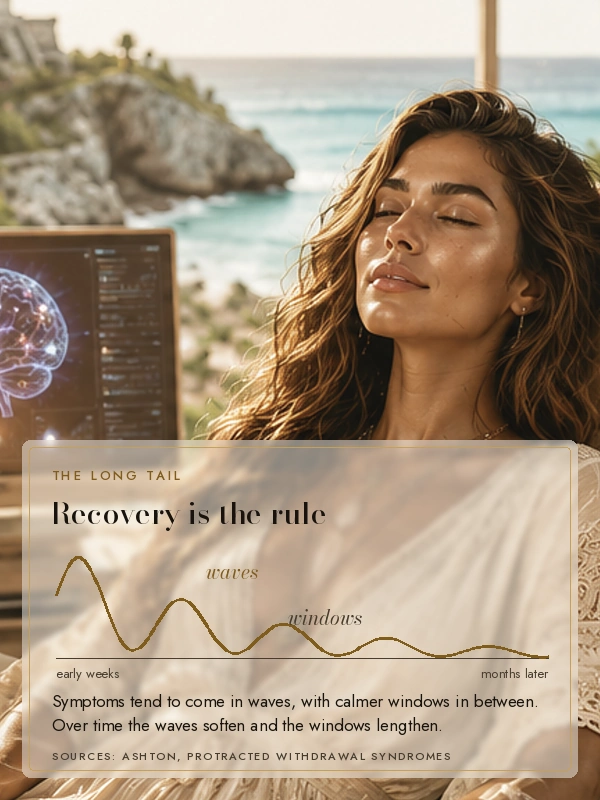
People in recovery often describe it in two words. A wave is a stretch, hours to weeks, when symptoms flare again. A window is a stretch when they lift, sometimes for the first time in months, and life feels close to normal.
These are not clinical terms. They are the language people found for an experience that sources do describe: symptoms whose severity fluctuates while slowly declining over time.[3][5]
Over the years, I have watched the same pattern again and again. In the early months, windows are short and waves are long. Gradually that reverses. Windows last longer. Waves come less often and feel less intense.
The difficulty is that a wave after a good window can feel like going backwards. It usually is not. Tracking how you feel week to week, rather than day to day, often makes the overall direction easier to see.
Common things that can stir up a wave include stress, poor sleep, illness, and sometimes alcohol or caffeine. Professor Ashton advised that alcohol and caffeine are best avoided or kept to a minimum during withdrawal.[1]
Recovery is the rule
This is the most important part of the page.
In her review of protracted syndromes, Professor Ashton wrote that symptoms "improve gradually for many months after withdrawal."[5] An earlier paper of hers, from 1985, put it more simply: "Although symptoms may be persistent, eventual recovery appears to be the rule."[3]
The timescale is the hard part. For some people it is a few months. For others it is longer. No one can honestly give you a date, and I would be wary of anyone who does.
What the evidence does support is direction. The nervous system adapted to the medication over time, and it can readapt without it over time.
Professor Ashton also made an observation that many people find steadying: these symptoms are generally not fully relieved by restarting a benzodiazepine.[5] That does not mean a clinician should never adjust your plan. It means that going back on the medication is not, by itself, a cure for protracted symptoms, and any decision about it belongs with your prescriber.
In fifteen years of this work, the people I have seen recover were not the ones who found a shortcut. They were the ones who had the right support while time did its work. Our guide to benzodiazepine withdrawal treatment compares the kinds of support available.
Support that helps
There is no single treatment for protracted withdrawal. There are, however, several things that sources and experience suggest can make the road more manageable.
- A clinician who takes it seriously. Ongoing review can rule out other causes, and some lingering symptoms, low mood in particular, may respond to specific treatment.[5]
- Psychological and behavioral support. Professor Ashton noted that recovery may be hastened by behavioral treatments, such as approaches that help with anxiety and stress.[5]
- A taper paced to you. If you are still tapering, the 2025 guideline supports slowing down or pausing when symptoms are hard to bear.[7]
- Steady routines. Regular sleep and wake times, regular meals, gentle movement and daylight give the nervous system predictability.
- Fewer stimulants and no alcohol. Both can make symptoms harder to read and harder to live with.[1]
- Accurate information. Knowing that waves are expected, and that the overall direction is recovery, can lower the fear that feeds symptoms.
For a broader view of where protracted symptoms sit in the whole process, see the main page on the benzo withdrawal timeline.
Some people are best served by more structure than home can provide. At Benzo Detox Protocol, our benzo program was built for people who could not get off at home, or who tried a detox and went back up. Most guests stay about twelve weeks, and harder cases can take longer. The taper is paced individually by our medical team, alongside around nine hours a day of one-to-one care, 24-hour nursing and a private suite. Depending on the person, the plan may include the Brain Repair IV Drip, a proprietary formulation incorporating amino acids, peptides, and a nature-derived alkaloid. It is one component of a comprehensive, individualized protocol, intended to support the body and brain during recovery, not presented as a guaranteed cure. Nutrition, red light therapy, the hyperbaric chamber, infrared sauna and detox baths may also be part of it. In fifteen years, no guest has had a seizure here. See how our 12-week benzo detox program works.
Questions about protracted benzo withdrawal
How long does protracted benzo withdrawal last?
It varies. For some people, lingering symptoms ease over a few months; for others it takes longer. Sources agree that symptoms generally improve gradually over time, and that eventual recovery appears to be the rule.
How common is protracted withdrawal?
It affects a minority. Professor Ashton estimated perhaps 10 to 15 percent of long-term users, and NHS Scotland guidance estimates up to 15 percent. Most people who taper carefully do not develop long-lasting symptoms.
Is it normal to feel worse months after my last dose?
Symptoms can return in waves, even after good stretches. That pattern is commonly described. Still, any new or severe symptom should be reviewed by a clinician, because other conditions can look similar.
Will going back on the benzodiazepine fix it?
Professor Ashton observed that protracted symptoms are generally not fully relieved by restarting a benzodiazepine. Any change to your medication should be decided with your prescriber.
Does a slower taper reduce the risk?
Coming off too quickly is one of the factors most often linked with severe symptoms. The 2025 joint guideline recommends starting with 5 to 10 percent reductions every two to four weeks, adjusted to how you respond.
Is protracted withdrawal the same as brain damage?
No source we rely on describes it that way. It is better understood as a nervous system that is still readjusting, which is why improvement, though slow, is the usual direction.
Sources
- Ashton CH. Benzodiazepines: How They Work and How to Withdraw (The Ashton Manual)
- NHS Scotland. Benzodiazepines and Z-drugs: discontinuation and withdrawal symptoms
- Ashton CH. Benzodiazepine dependence and withdrawal: an update (1985)
- FDA Drug Safety Communication: Boxed Warning for the benzodiazepine class (2020)
- Ashton CH. Protracted withdrawal syndromes from benzodiazepines (1991)
- Ritvo AD et al. Long-term consequences of benzodiazepine-induced neurological dysfunction: a survey. PLOS ONE (2023)
- Joint Clinical Practice Guideline on Benzodiazepine Tapering, Journal of General Internal Medicine (2025)